

CD Market
Offers


Trailers & screenshots
1 / 12
About CD Market
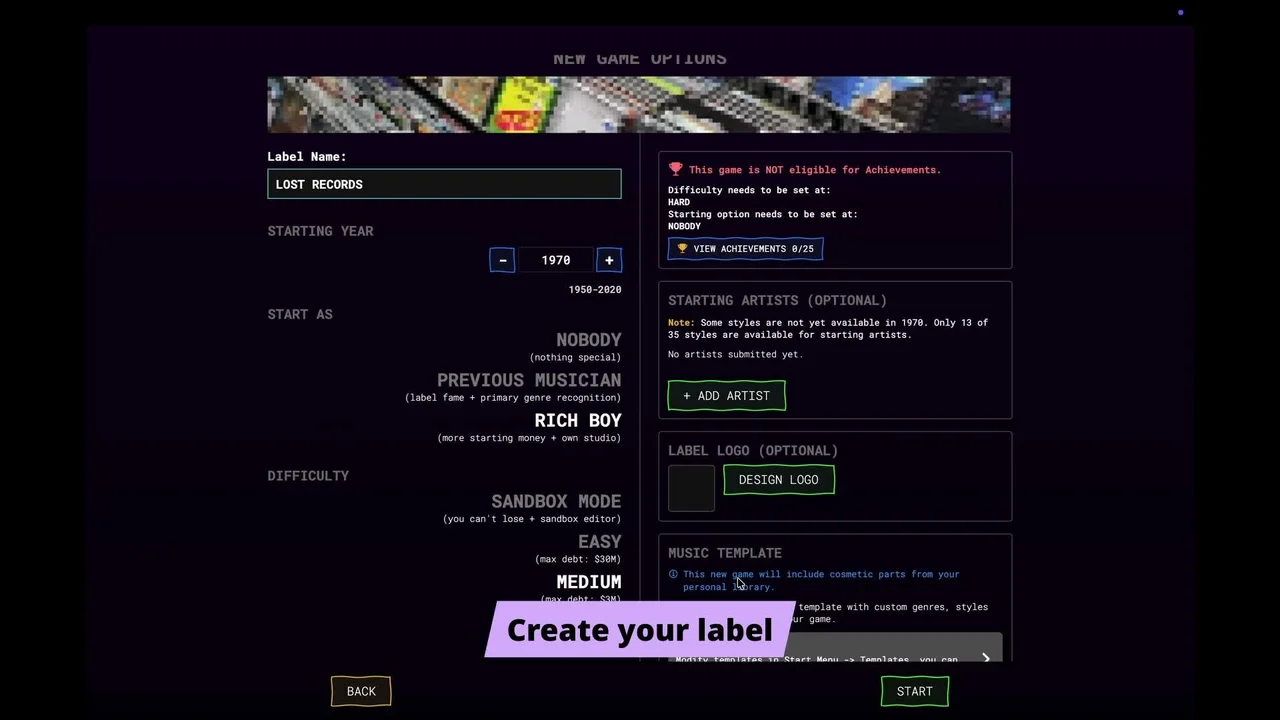
CD Market is a music label management game about building a small record label through decades of music history. You sign artists, shape their careers, make and release records, promote them, send artists on tour and try to keep the business afloat as the industry changes. Start in any year from 1950 to 2020, then keep playing beyond 2020 to see how long your label can survive.
Manage artists
Use your A&R department to scout artists, solo members and future stars. Negotiate contracts, advances, royalties, renewals and EP deals, and decide which artists belong on your roster long term. Artists have creative energy, stress, boredom, happiness, chemistry, traits and personal problems; they can burn out, fall apart, lose members, retire, get poached or demand better terms as they become famous.
Make and release records
Choose a project’s creative direction, style and theme, then book demos, hire writers and producers, record songs and decide what to release. Projects can become singles, albums, EPs, promo singles, compilations, greatest hits releases or special editions. Choose formats such as Vinyl, Cassette, CD and Digital, along with regions, prices, publishers, marketing budgets and distribution options. The business shifts across the eras, from physical formats, regional distribution and record stores to piracy and digital platforms.
Promote your artists
Run marketing campaigns and PR events, send music to radio, make videos for TV and build anticipation before an album release. Promotion can grow recognition across regions, while commercial placements, collaborations and award-show performances can provide further opportunities. Track sales, profits, certifications, piracy impact, chart positions and regional recognition as global charts move each week and new styles emerge.
Tour and build festivals
Plan tours by choosing venues, ticket prices, dates, setlists and supporting artists. Manage travel and amenities, rehearse and see how each show affects reputation, stress, ticket sales and future demand. You can also create merch sets, work with suppliers, order stock, set prices and sell merchandise to fans.
Festivals can become part of your label’s identity. Get your artists onto festival lineups or create your own event: book a venue, set the schedule, invite label and global artists, manage the budget and try to make it memorable to fans.
Keep the label running
Rival labels compete for artists, while legal cases can drain cash and piracy can damage sales if left unchecked. Handle lawsuits through settlements or court, run anti-piracy campaigns, pursue awards and respond to changing artist and market conditions. Build departments, hire employees and executives, and make decisions that determine whether your label thrives or fails.
As the company grows, you can build a studio, move to better offices, open distribution centers and record stores, buy radio stations, make distribution deals with rival labels or acquire other labels. Executives can take on ongoing work: marketing executives manage PR, HR executives recruit and staff departments, tour executives forecast tour prospects, and distribution executives help manage retail infrastructure, store costs and rival-label deals. Release executives can plan demos, schedule recordings, prepare singles and assemble album drafts for your final approval.
Sandbox mode
Sandbox mode lets you adjust the label’s cash, recognition, genre popularity, release settings, ticket-price limits, manufacturing costs and employee setup. You can create and edit artists, change their members and traits, adjust happiness and chemistry, and set up a roster to your liking. Use these options to test strategies, skip the early struggle, recreate a music scene or experiment with the game’s numbers.
Key features
- Start in any year from 1950 to 2020 and continue endlessly.
- Scout artists, solo members and future stars through A&R; negotiate contracts, advances, royalties, renewals and EP deals.
- Manage artist happiness, chemistry, stress, boredom, burnout, addiction and band drama.
- Create demos, record songs, choose writers and producers, and develop album projects.
- Release singles, albums, EPs, compilations, greatest hits, promo singles and special editions in different formats and regions.
- Run PR events, marketing campaigns, radio promotion, TV exposure and commercial deals.
- Plan tours with venues, ticket prices, setlists, support acts, travel, amenities and show ratings; create merch and manage its supply and sales.
- Compete for awards, perform at ceremonies and create festivals featuring label or global artists.
- Handle legal cases, settlements, court outcomes and anti-piracy campaigns; compete with rival labels, sign global artists or acquire subsidiaries.
- Build distribution centers, open record stores, make deals with other labels and buy radio stations.
- Use Sandbox mode to edit your label, artists, money, recognition and more.
- Create or import music templates with different genres, styles, regions, stores, publishers and radio stations.
- Unlock achievements for sales, tours, awards, formats, legal cases, stores and digital music.
Frequently asked questions
The best price for CD Market is $19.99 at Steam. It is the only shop with an offer that activates in your country.
The minimum requirements for CD Market are: Windows 10, Intel HD Graphics 4000, Intel Core i3, 4 GB RAM, 1,000 MB storage. It also runs on macOS. The recommended specs are in the System requirements section.
No. CD Market is a single-player game.
Yes. Valve rates CD Market as Verified on the Steam Deck: it runs well out of the box.
Yes. CD Market is the full base game. You need nothing else to play it.
Steam lets publishers create keys to sell in other shops. Once you activate a key, the game is yours to keep, just like a store purchase.
Disclaimer: CD keys have an inherent 1–2% average failure rate. Check the shop terms for buyer protection info. Steam offers no buyer protection for keys bought in other shops and doesn't refund them.
Similar games

Big Ambitions
$25.99
4 offers
Supermarket Simulator
−55%$8.83
$19.9918 offers
Game Dev Tycoon
−43%$5.61
$9.9912 offers
Wall Street Raider
$29.99
1 offer
TCG Card Shop Simulator
$19.99
1 offer
Startup Company
−20%$10.31
$12.999 offers
Gear City
−45%$10.99
$19.994 offers
Capitalism II
−60%$3.94
$9.9915 offers
City Bus Manager
−11%$26.60
$29.9910 offers

Waterpark Simulator
$12.99
1 offer

Stonks-9800: Stock Market Simulator
$9.99
3 offers
Mall Simulator
$13.99
1 offer