

Get Total War: Warhammer Bretonnia for PC
Offers


Screenshots
1 / 17

About Total War: Warhammer Bretonnia
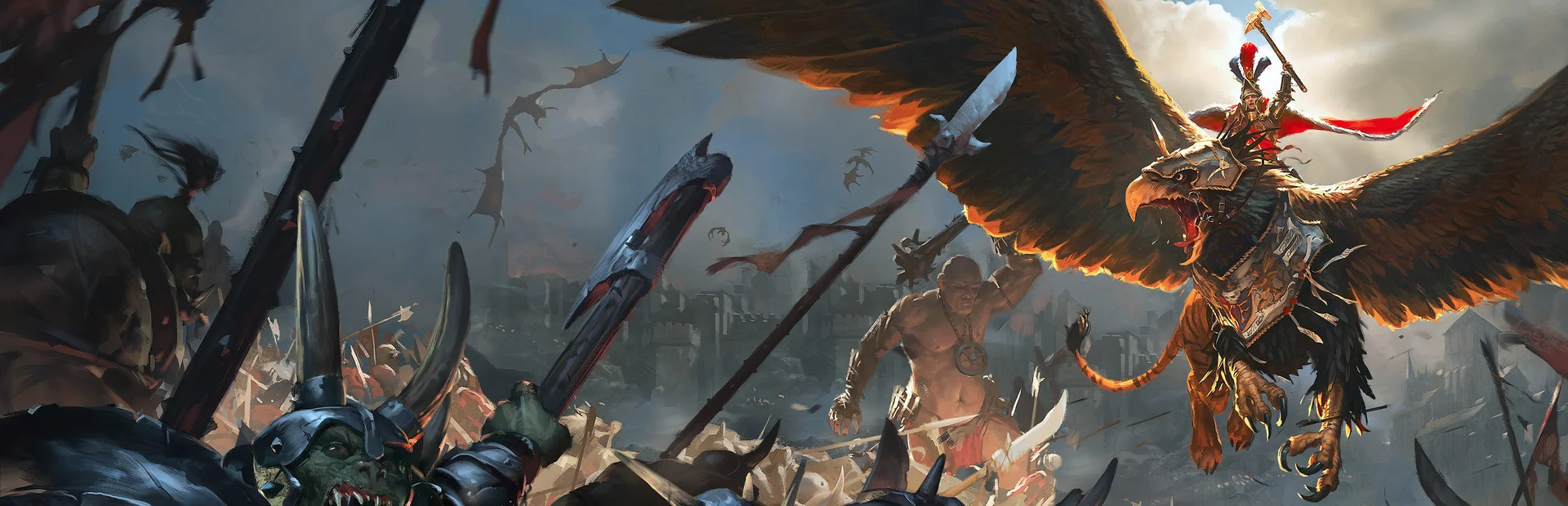
Total War: Warhammer Bretonnia adds Bretonnia as a playable race in the Grand Campaign, with an expanded roster for custom and multiplayer battles. You lead one of three Legendary Lords—Louen Leoncoeur of Bretonnia, Alberic of Bordeleaux or The Fay Enchantress of Carcassonne—and guide the kingdom through campaign mechanics shaped by chivalry, peasant resources and knightly vows. Bretonnia’s endgame objective is the Errantry War, a climactic battle against its foes.
The kingdom of Bretonnia
Founded by Gilles le Breton in the regions between the Great Ocean and The Grey Mountains, Bretonnia is a feudal kingdom now ruled by warrior-king Louen Leoncoeur and divided into dukedoms. Its people follow a code of chivalry and offer fealty to The Lady of The Lake; knights who distinguish themselves through honourable deeds may earn her blessing.
Peasants till the soil in return for noble protection, providing the income that funds Bretonnia’s military. They owe nine-tenths of their earnings to their liege, while each level of society has its own vows and responsibilities. Young Knights Errant may begin with a brash attitude towards the serfs, but learn to take on the solemn, honourable bearing expected of protectors of the realm.
Bretonnia faces threats from several directions: Athel Loren’s wild woodlands are awakening to the east, Greenskins infest the nearby Grey Mountains, and the northern coast is exposed to seaborne attacks from Norsca.
Chivalry and campaign
Your actions affect a chivalry meter shown at the top of the campaign interface. Winning heroic battles and completing quest chains raise chivalry, improving Control, granting bonus unit experience and reducing corruption. Warring with other Bretonnian factions or sacking settlements can lower it; low chivalry reduces Control and army Leadership and can contribute to rebellions across your provinces.
As your campaign advances, reaching a chivalry threshold presents a dilemma that leads to the Errantry War, a climactic endgame battle rooted in Bretonnian lore. A suitably chivalrous leader can also call upon the Green Knight, while an unchivalrous one cannot.
After a Lord and their army win a Heroic Victory, they receive the Blessing of The Lady, which grants a Ward Save in future battles. A unit that routs loses the blessing for the rest of that fight, and an army that refuses a battle on the campaign map loses it as well. Certain high-tier units, including Grail Knights, have the blessing as a unit trait by default.
Peasant resources
Each region you own contributes a set number of peasants to your total, with your capital providing the most. Peasants support the economy through farming, workshops and mining, and can also serve as militia. Committing more of them to your armies leaves fewer available for agricultural work and its income.
You can focus construction on industry rather than farming to reduce the economic impact of recruiting many peasants, though industrial income is generally lower. Technologies can significantly improve that income.
Lords and heroes
The three new Legendary Lords lead campaigns from their respective regions:
- Louen Leoncoeur (Bretonnia): A melee-focused Lord who can ride a Barded Warhorse, a Royal Pegasus or Beaquis, the legendary Hippogryph.
- The Fay Enchantress (Carcassonne): The personal representative of The Lady of The Lake and the most influential figure in Bretonnia. She is a spellcaster who wields the Lore of Life and can ride her unicorn, Silvaron.
- Alberic (Bordeleaux): A melee-focused Lord known for his courage and exacting standards. He can ride a Barded Warhorse, a Royal Pegasus or a Hippogryph.
Bretonnian armies can also recruit Lords and Prophetesses from the Lords pool. Prophetesses wield the Lores of Beasts, Heavens or Life. Lords and Prophetesses have race-specific skills, including the Knight’s Vow, Questing Vow and Grail Vow, which reduce upkeep for the corresponding knightly orders in their armies.
Paladins are battle-hardened knights renowned for valour and chivalry, and charge into battle on swift Pegasus mounts. Damsels, trained in magic after a journey to the Otherworld, serve as advisors and battle-mages; they can wield the Lores of Beasts, Heaven or Life.
Bretonnian forces
The army is built around mounted knights, supported by peasant infantry and archers, inexpensive yeoman cavalry, field trebuchets, religious zealots and icons of The Lady. Its roster includes:
- Melee infantry: Peasant Mob, Foot Squires, Spearmen-at-arms, Spearmen-At-Arms (Shields), Men at arms, Men-At-Arms (Shields), Men-At-Arms (Polearms), Grail Reliquae and Battle Pilgrims.
- Ranged infantry: Peasant Bowmen, Peasant Bowmen (Fire Arrows) and Peasant Bowmen (Pox Arrows).
- Melee cavalry: Mounted Yeomen, Knights Errant, Knights Of The Realm, Questing Knights, Grail Knights and Grail Guardians.
- Ranged cavalry: Mounted Yeomen Archers.
- Flying cavalry: Pegasus Knights, Royal Pegasus Knights and Royal Hippogryph Knights.
- Artillery: Field Trebuchet and Blessed Field Trebuchet.
The Green Knight
A legendary protector of Bretonnia, the Green Knight challenges Questing Knights to prove themselves to The Lady of The Lake. He wears ivy-covered armour, carries The Dolorous Blade and rides his spirit-charger Shadowsteed.
A sufficiently chivalrous Legendary Lord can summon him a limited number of times during a campaign. He appears temporarily as a Legendary Hero with preset skills and abilities.
Frequently asked questions
Yes. Total War: Warhammer Bretonnia is free to play on Steam, so there is nothing to buy to start playing.
No. Total War: Warhammer Bretonnia is DLC and only works with Total War: Warhammer.
The minimum requirements for Total War: Warhammer are: Windows 7, Radeon HD 5770, Intel Core 2 Duo, 3 GB RAM, 35 GB storage. It also runs on macOS. The recommended specs are in the System requirements section.
Yes. Total War: Warhammer has multiplayer and a single-player mode. It supports online co-op, online PvP and LAN play.
Mostly, yes. Valve rates Total War: Warhammer as Playable on the Steam Deck: it runs, but may need some manual setup.
Similar games
Age of Wonders III
−96%$1.15
$29.9918 offers
Warhammer 40,000: Gladius - Relics of War
−95%$1.87
$39.9920 offers
Total War: Three Kingdoms
−81%$7.55
$39.9918 offers
Total War: Attila
−79%$4.18
$19.9922 offers
Warlords Battlecry III
−40%$5.99
$9.9913 offers
SpellForce: Conquest of Eo
−96%$1.00
$29.9922 offers
Ultimate General: Civil War
$29.99
4 offers
Songs of Conquest
−84%$4.66
$29.9919 offers
Heroes' Vow: Three Kingdoms
$19.99
1 offer
Sid Meier's Civilization VI
−91%$5.33
$59.9922 offers
Menace
−49%$20.24
$39.9920 offers
Battle Brothers
−78%$6.42
$29.9915 offers