

Get TheHunter: Call of the Wild New Species 2018 for PC
Offers


Screenshots
1 / 18
theHunter series


About TheHunter: Call of the Wild New Species 2018
TheHunter: Call of the Wild New Species 2018 adds four animal species to the game’s hunting reserves: Gemsbok in Vurhonga Savanna, mallards in Layton Lake District, Canada geese in Hirschfelden and white-tailed jackrabbits in Layton Lake District. Each has distinct habits, senses and fur or plumage variations.
Gemsbok
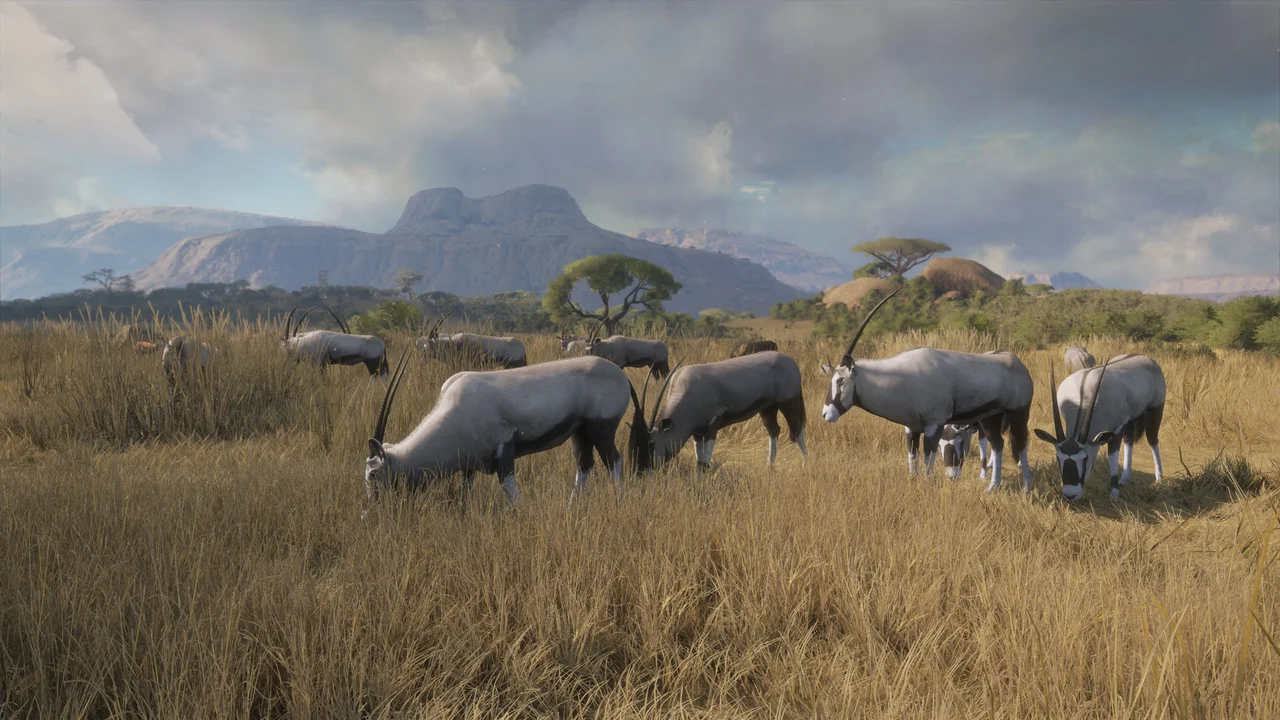
Grandfather Njabulo reintroduces Gemsbok to a healthy, thriving Vurhonga Savanna. The largest of the three members of the Oryx genus, it has long, pointed horns that can grow over 160 cm and thick skin around its neck for protection from predators and rivals. Gemsbok live in mixed herds and roam nomadically, rarely remaining in one territory long enough to overgraze it.
Gemsbok are alert, careful and patient, tending to move slowly and avoid predators rather than flee in a hurry. Their keen smell, hearing and eyesight make them difficult to approach unnoticed. They have five fur variations: the common grey coat with black and white details, and four rarer variations.
Mallards
Mallards appear in Layton Lake District. Males have an iridescent-green head and bright yellow bill, while females have mottled brown plumage and orange-brown bills. These medium-sized dabbling ducks feed on underwater prey and plants, allowing them to live in many wetland habitats. They usually spend their days between two bodies of water: one for resting, preening and socializing, and another for feeding.
Mallards have good eyesight but poor hearing and smell. They can be found at either of their two favored locations, where careful planning can help you catch them by surprise. Alongside their common plumage, they have up to eight rare variations.
The Beacon Deluxe Duck Caller is an acrylic caller with a powerful long-range call that cuts through high winds and rain. Used near lake shores, it can attract flying mallards and increase the chance they land nearby; mallards are more likely to land when it is used with appropriate decoys.
Canada geese
Canada geese appear in Hirschfelden. Their white chinstrap distinguishes them from other geese, and they occupy habitats ranging from tundra and prairielands to mountainous fields. They form lifelong partnerships early in life and migrate in flocks, often flying in V-shaped formations. They are always found in groups and have excellent hearing and vision, but a poor sense of smell.
Their four plumage variations include the common brown-bodied form, Brown Leucistic, Grey Leucistic and Bold Leucistic. The Short Reed Canada Goose Caller, handcrafted by CMS Sweden’s master craftsman Charlie Sandin, reproduces vocalizations including clucks, honks, murmurs and moans. Clucks and honks attract geese from a distance, while murmurs and moans can put them at ease up close; the caller works at both short and long ranges.
White-tailed jackrabbits
White-tailed jackrabbits, also known as Prairie Hares or White Jacks, were first observed in Layton Lake District in March 2018. This hare species is native to the Pacific Northwest. Fast and agile, it has an excellent sense of smell, though its vision is weaker than that of other species in the reserve. It is usually solitary and interacts briefly with other hares only during mating season.
Five fur variations have been observed: four common forms and a rare albino variation.
Reserve species
When the reserves first opened, 12 animal species were huntable across Layton Lake District and Hirschfelden Hunting Reserve. Medved-Taiga National Park added four species, and Vurhonga Savanna added seven. The reserves’ ecosystems continue to change, sometimes bringing new species.
Frequently asked questions
Yes. TheHunter: Call of the Wild New Species 2018 is free to play on Steam, so there is nothing to buy to start playing.
No. TheHunter: Call of the Wild New Species 2018 is DLC and only works with TheHunter: Call of the Wild.
The minimum requirements for TheHunter: Call of the Wild are: Windows 7, GeForce GTX 660, Intel Core i3-4170, 4 GB RAM, 140 GB storage. It runs on Windows only. The recommended specs are in the System requirements section.
Yes. TheHunter: Call of the Wild has multiplayer and a single-player mode. It supports online co-op.
Mostly, yes. Valve rates TheHunter: Call of the Wild as Playable on the Steam Deck: it runs, but may need some manual setup.
Similar games
Way of the Hunter
−87%$3.69
$29.9925 offers

Far Cry 3
−82%$3.59
$19.9913 offers
Monster Hunter Rise
−88%$4.40
$39.9926 offers

Homefront: The Revolution
−87%$2.58
$19.9918 offers
Green Hell
−74%$2.23
$8.9124 offers

Prehistoric Hunt
$17.99
2 offers

Conan Exiles
−67%$12.93
$39.9924 offers

Hunting Simulator 3
−48%$20.63
$39.9919 offers

Animalia Survival
$19.99
1 offer
The Long Dark
−57%$8.43
$19.9917 offers
Dovetail Games: Euro Fishing
−88%$1.79
$14.9921 offers
Rake
$4.99
1 offer