

The Political Process
Offers






Trailers & screenshots
1 / 67
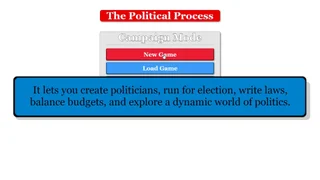
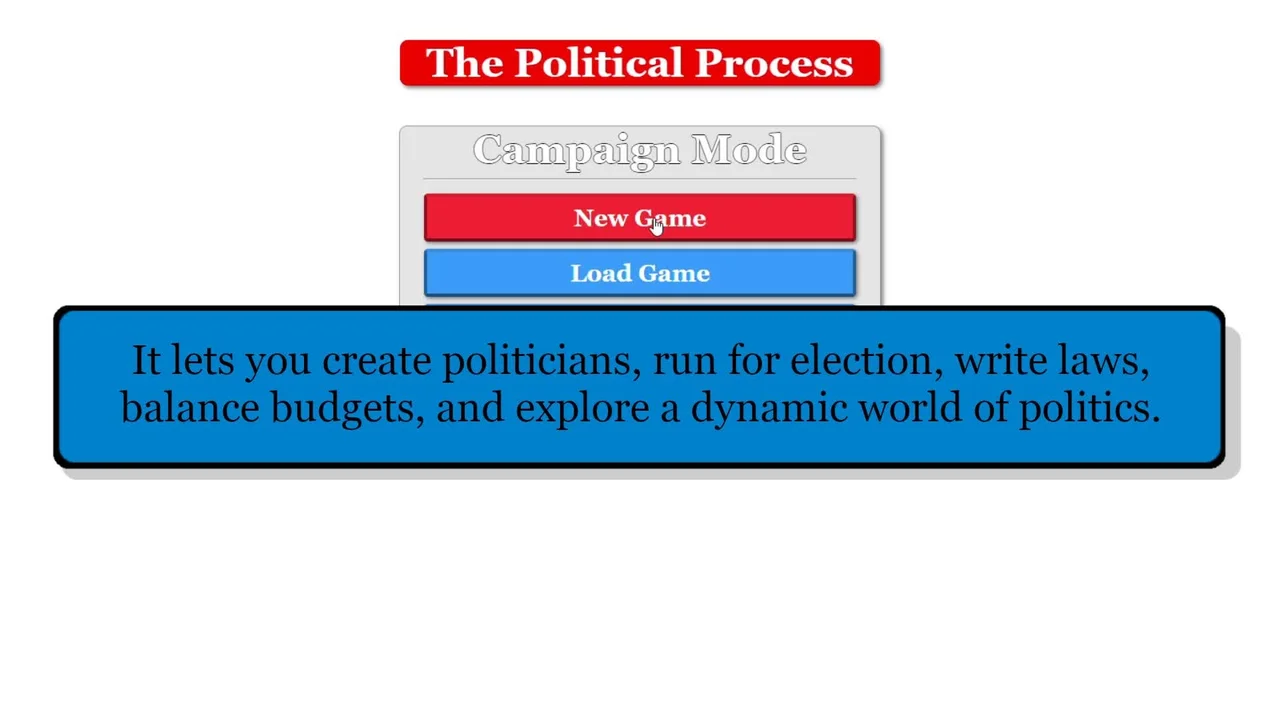

About The Political Process
The Political Process is a turn-based political simulator set in the American political system. You create a politician, campaign for office, write legislation and balance budgets as you move through the political hierarchy. Play as a Democrat or Republican, and shape your character’s name, age, appearance, ideology, backstory and motives. You can choose from over 40 policy positions covering social and fiscal issues.
Choose a district
You can play in any of the 50 states and more than 3,000 counties, each based on real-life data. Advanced options let you change over 80 variables, including voter demographics, ideology, turnout, district population and poverty rates.
Campaign for office
You can run for nine positions at city, state and national levels: school board, city council, mayor, state house, state senate, governor, U.S. House of Representatives, U.S. Senate and president. Campaigns include primaries and general elections. You build a platform, knock on doors, coordinate volunteers, raise funds, hold rallies, conduct polls and organize marketing campaigns to build name recognition, sway public opinion, influence voter enthusiasm and increase turnout.
A presidential campaign requires you to divide resources among all 50 states, deciding which are safe, which could be won and which to leave aside. You can tailor your message to each state, court independent voters in swing states, increase turnout among supporters or use attack ads to reduce enthusiasm for your opponent. You also need to consider congressional elections: campaigning in a state you cannot win may still raise turnout enough to help party members win their races.
Make laws and budgets
You can choose from over 80 types of legislation covering areas such as taxes, education, crime, health care and poverty. Options include adjusting tax rates, changing Social Security benefits, eliminating food stamps, increasing higher education grants, reducing jail terms and creating free community college. Bills go through committee hearings, amendments and legislative votes; politicians vote according to their ideologies and policy positions. If a bill passes, it goes to the mayor, governor or president to be signed or vetoed. Laws affect a range of in-game metrics.
Leadership positions let you propose budgets, which require legislative approval. You set tax policy and decide how to allocate revenue among government programs, choosing what to support or eliminate. Budgets use real-life data to provide a simplified representation of the process.
Build political influence
Winning elections and passing laws earn political points, which represent your political experience. They determine which committees you can join and whether you can chair one. A chairperson decides whether legislation within their committee receives a hearing, giving them the power to prevent it from becoming law. Political points also affect whether you become party leader or caucus leader, positions that give you influence over other politicians’ votes. Reaching leadership requires many terms in office.
A changing political world
More than 600 procedurally generated politicians have their own ideologies, personalities and careers. The game simulates their primary and general elections, and you can review the results after each election. Politicians retire, seek higher office or lose primaries to challengers; a city council member might become governor, while senators may run for president. You can follow changes in the balance of power and consider how government approval ratings may affect future elections.
The game also simulates constituents through more than 100 metrics shaped by starting conditions and government policies. You can track how those measures change over time, including poverty, education and the federal deficit.
Other ways to play
As a Campaign Committee Chairperson, you recruit candidates, adjust their policies and use party resources to influence public opinion and turnout. You can choose primary challengers for party members or recruit moderates if you want to shift a party that is becoming too radical. Your choices can affect the party’s ideology and its success, and you decide whether to focus resources on turnout or use marketing over multiple elections to change public opinion.
Dictator Mode lets you play as president without seeking reelection, pass legislation and control the budget without congressional interference. You can use it to test ways to balance the federal budget or see how combinations of laws affect the country. The Election Simulator predicts an election based on values you set, including public opinion, candidate attributes and party demographics.
Political consequences
Campaign messages affect voter enthusiasm and turnout: an extreme platform may cost you independent voters, while a moderate one may leave you vulnerable to a partisan challenger in the primary. Your votes on legislation affect your approval rating and may influence whether you face a primary challenger. Laws can have linked effects across more than 100 metrics. For example, eliminating food stamps can reduce children’s access to nutrition, which may affect school performance, graduation rates, poverty, crime, jail populations and tax revenue, creating further budget pressures.
Political decisions often involve trade-offs. You may need different strategies for a primary and a general election, vote for legislation you oppose to gain support for another bill, or avoid running for higher office when an incumbent is difficult to defeat. Elections and legislation can be difficult to win or pass, and some may not be possible in a given situation. There are no win conditions: you play a politician’s career and can retire whenever you choose.
Frequently asked questions
The best price for The Political Process is $14.99 at Steam. 3 shops have an offer that activates in your country.
Some are. This page only shows offers that activate in your country; offers for other regions, or with no stated region, are left out. To see the offers for another country, change your country at the top of the page.
Every key we list activates on Steam. Redeem the key there and The Political Process stays in your library for good.
Yes, with a small risk. Publishers create keys to sell in other shops, which is why a key can cost less than in the official store, and once you activate it the game is yours to keep, just like a store purchase. On average 1–2% of keys fail, so check the shop's buyer protection before you buy: the official store does not refund keys bought elsewhere.
The minimum requirements for The Political Process are: Windows 10, 2 GB RAM, 500 MB storage. It runs on Windows only. The recommended specs are in the System requirements section.
No. The Political Process is a single-player game.
Mostly, yes. Valve rates The Political Process as Playable on the Steam Deck: it runs, but may need some manual setup.
Steam lets publishers create keys to sell in other shops. Once you activate a key, the game is yours to keep, just like a store purchase.
Disclaimer: CD keys have an inherent 1–2% average failure rate. Check the shop terms for buyer protection info. Steam offers no buyer protection for keys bought in other shops and doesn't refund them.
Similar games
Democracy 3
−70%$7.49
$24.9912 offers

Long Live the Queen
−60%$3.99
$9.999 offers
SuperPower 2: Steam Edition
−86%$1.36
$9.9911 offers
Crisis in the Kremlin
$4.99
6 offers

Fate of the World
$9.99
1 offer
Beholder: Conductor
−92%$1.11
$13.9921 offers
The Political Machine 2016
$1.51
7 offers
Power & Revolution: 2019 Edition
−55%$22.49
$49.991 offer
Comrade Trump's Re-election
$2.99
1 offer
TheoTown
$9.99
1 offer
Riot: Civil Unrest
−93%$1.08
$16.9917 offers
Rogue State
−33%$3.31
$4.996 offers