

Buy IL-2 Sturmovik: Battle of Stalingrad IL-2 Sturmovik: Ta 152 H-1 Collector Plane PC key
Offers


Screenshots
1 / 13
IL-2 Sturmovik series
About IL-2 Sturmovik: Battle of Stalingrad IL-2 Sturmovik: Ta 152 H-1 Collector Plane
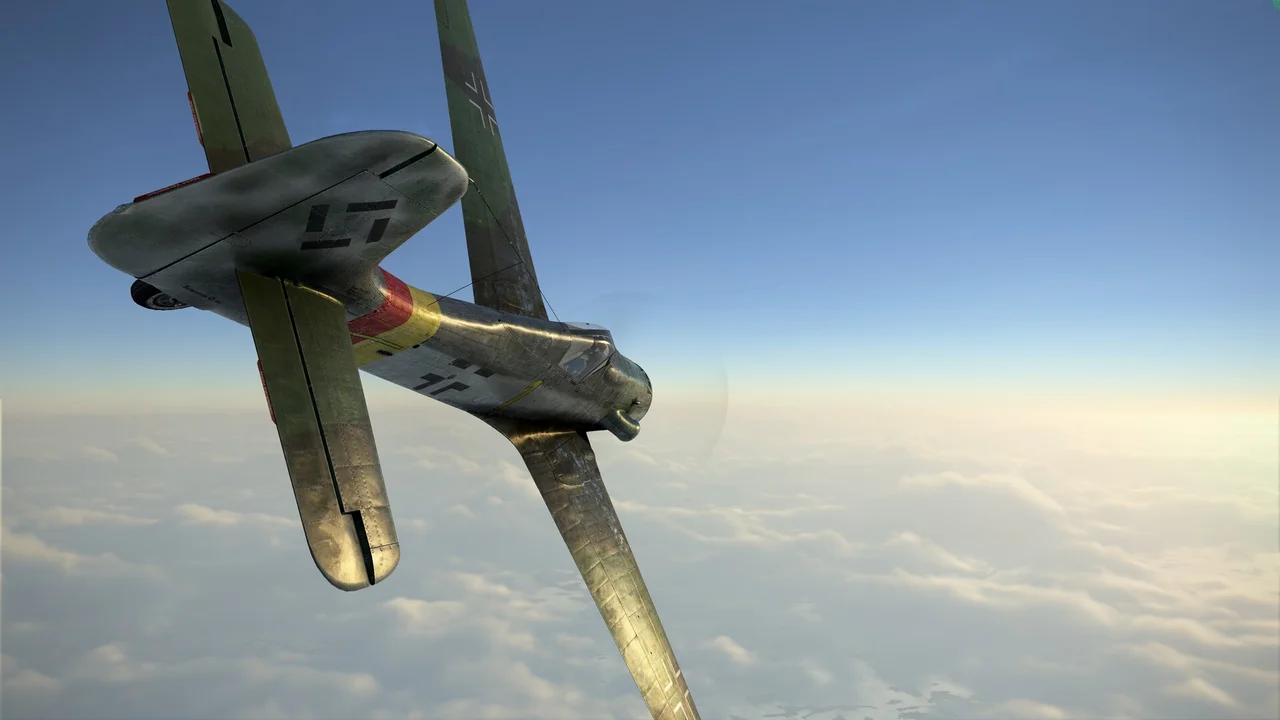
IL-2 Sturmovik: Ta 152 H-1 Collector Plane adds the German Ta 152 H-1 fighter to IL-2 Sturmovik: Battle of Stalingrad. The aircraft can be flown in Quick Mission Builder, Advanced Quick Mission Generator and Multiplayer, as well as in Career mode during the Battle of Bodenplatte timeframe as I./JG 11 after March 1, 1945.
The Ta 152 H-1
Designed by Kurt Tank, the Ta 152 was the final development of the Fw 190 fighter. Its name changed from “Fw” to “Ta” in recognition of Tank’s contribution. The H-1 entered production at the end of the Second World War and appeared over Germany in early 1945; about 25 H-1s were produced, too few to affect the course of the war.
Compared with the Fw 190D “Dora,” the Ta 152 has a longer fuselage and a wider wingspan to improve maneuverability at high altitude. Its Jumo-213E engine has a two-stage, three-speed supercharger and two boost systems: MW-50 water-methanol injection for low and medium altitudes, and GM-1 nitrous oxide injection for high altitudes. A pressurized cockpit supports high-altitude flight. The aircraft can reach 750 km/h at 12 km and has a service ceiling of 14 km.
Weapons and appearance
The default armament consists of a nose-mounted 30mm MK 108 cannon with 85 rounds, firing at 650 rounds per minute, and two wing-mounted 20mm MG 151/20 cannons, each with 175 rounds and a rate of fire of 700 rounds per minute. The EZ42 Gyro Gunsight is available as a modification, adding 13 kg.
The aircraft includes these paint schemes:
- Alternative grey and green camouflage: RLM 74/75, with a customizable tactical number.
- Jagdgeschwader 301: a paint scheme with a customizable tactical number.
- Oberfeldwebel Willi Reschke: 7./JG 301, Alteno, April 1945.
- Roderich Cescotti and Willi Reschke: III./JG 301, Leck, Germany, April 1945.
- Oberfeldwebel Walter Loos: Stab./JG 301, Neustadt-Glewe, Germany, April 30, 1945.
- Oberstleutnant Fritz Aufhammer: Stab./JG 301, Stendal, Germany, March 22, 1945. Aufhammer flew the aircraft to the Focke-Wulf factory at Rechlin for a meeting about Ta 152 production. Because it was a new and unfamiliar type, he ordered it painted red to help it survive German Flak crews along the route.
Flying the aircraft
The engine systems are extensively automated: in normal flight, you control speed with the throttle, without manually setting engine revolutions, mixture or supercharger gear. The supercharger changes gear automatically according to altitude and engine revolutions, and the radiator flaps regulate coolant temperature automatically. You can adjust the coolant thermostat if needed.
MW-50 prevents engine detonation during emergency power use and can be activated by the pilot at altitudes up to 10,000 m. It can operate for a total of 28 minutes, and a warning light indicates when injection is not active. GM-1 supplies additional oxygen to let the engine operate above its rated altitude; it can be activated from 11,000 m and operates for a total of 17 minutes.
The wings can stall suddenly at critical angles of attack, with almost no warning buffet beforehand, so you need to take care during extreme maneuvers. The aircraft has no flight-control trimmers; ground personnel can set its bendable trim tabs before flight. An electrically actuated horizontal stabilizer is adjusted manually and should be set to +1.5° for takeoff and landing. It can also trim the flight stick in flight, including during a deep dive.
The hydraulic landing flaps can be extended to any angle up to 73°, with their position shown by indicators on the wings. Pulling the flight stick back locks the tailwheel; it should be locked for long straight taxiing, before takeoff and after touchdown. Separate left and right hydraulic wheel brakes are controlled through the upper part of the rudder pedals.
The fuel gauge displays fuel remaining in the main fuselage tanks according to the selected switch position. There are no gauges for the wing tanks, and supplementary fuel flows into the rear fuselage tank. A white warning light flashes when the rear tank has about 10 liters left; a red one flashes when the front tank has about 80 liters left.
Cockpit pressurization begins automatically at 8,000 m, and a pressure gauge, ventilation switch and depressurization warning light are provided. The cockpit normally maintains an overpressure of 0.1–0.2 atu. Strong airflow prevents the canopy from being opened or closed at high speed, but it has an emergency release for bailouts. The gunsight also has a sliding sun filter.
Specifications
The aircraft is 10.71 m long, has a 14.4 m wingspan and a wing area of 23.5 m². Its empty weight is 3,877 kg, minimum weight is 4,184 kg, standard weight is 5,217 kg and maximum takeoff weight is 5,230 kg. Fuel capacity is 736 kg (995 liters), and useful load is 1,353 kg.
Its indicated stall speed in flight configuration is 170–192 km/h, compared with 156–178 km/h in takeoff and landing configuration. Takeoff speed is 175–210 km/h, glideslope speed is 190–210 km/h and landing speed is 155–175 km/h, at a landing angle of 12.5°. The dive speed limit is 750 km/h, the maximum load factor is 8.5 G, and the stall angle of attack is 19.1° in flight configuration and 17.7° in landing configuration.
Maximum true air speeds are:
- At sea level, emergency power with MW-50: 579 km/h.
- At 5,000 m, emergency power with MW-50: 663 km/h.
- At 9,500 m, emergency power with MW-50: 740 km/h.
- At 12,000 m, emergency power with GM-1: 756 km/h.
- At sea level, combat power: 541 km/h.
- At 10,700 m, combat power: 707 km/h.
- At 12,000 m, combat power: 678 km/h.
The climb rate is 17.5 m/s at sea level, 15.8 m/s at 3,000 m and 13.4 m/s at 6,000 m. Maximum-performance turns take 21.5 seconds at sea level and 26.9 seconds at 3,000 m, both at 280 km/h IAS. At 3,000 m, flight endurance is 4.6 hours at 350 km/h IAS.
Engine details
The Jumo-213 E1 produces 2,050 HP in emergency mode at sea level and 1,450 HP at 9,500 m. Combat power is 1,750 HP at sea level and 1,330 HP at 9,800 m; nominal power is 1,580 HP at sea level and 1,260 HP at 10,700 m.
- Nominal: unlimited, 3,000 RPM and 1.42 ata.
- Combat power: up to 30 minutes, 3,250 RPM and 1.51 ata.
- Emergency power: up to 3 minutes, 3,250 RPM and 1.7 ata.
- Emergency power with MW-50: up to 10 minutes, 3,250 RPM and 1.8 ata.
- Emergency power with GM-1: 3,250 RPM.
Rated water temperature at the engine outlet is 55–110 °C, with a maximum of 120 °C. Rated oil temperature is 40–120 °C, with a maximum of 135 °C. The supercharger gear changes automatically. The listed performance figures use the international standard atmosphere; speed, climb and turn figures use standard aircraft mass, while performance ranges reflect possible aircraft mass ranges. Climb rates are for emergency power with MW-50, and turn times are for combat power.
Frequently asked questions
The best price for IL-2 Sturmovik: Battle of Stalingrad IL-2 Sturmovik: Ta 152 H-1 Collector Plane is $19.99 at Steam. It is the only shop with an offer that activates in your country.
No. IL-2 Sturmovik: Battle of Stalingrad IL-2 Sturmovik: Ta 152 H-1 Collector Plane is DLC and only works with IL-2 Sturmovik: Battle of Stalingrad.
The minimum requirements for IL-2 Sturmovik: Battle of Stalingrad are: Windows 10, Intel Core i5, 16 GB RAM, 95 GB storage. It runs on Windows only. The recommended specs are in the System requirements section.
Yes. IL-2 Sturmovik: Battle of Stalingrad has multiplayer and a single-player mode. It supports online co-op and online PvP.
No. Valve rates IL-2 Sturmovik: Battle of Stalingrad as Unsupported on the Steam Deck.
Steam lets publishers create keys to sell in other shops. Once you activate a key, the game is yours to keep, just like a store purchase.
Disclaimer: CD keys have an inherent 1–2% average failure rate. Check the shop terms for buyer protection info. Steam offers no buyer protection for keys bought in other shops and doesn't refund them.
Similar games

X-Plane 11
$29.99
1 offer
Combat Wings: Battle of Britain
−88%$0.59
$4.9923 offers

Microsoft Flight Simulator X: Steam Edition
$24.99
2 offers
Project Wingman
−53%$11.72
$24.9915 offers

Ace Combat 7: Skies Unknown
−77%$13.48
$59.9923 offers
Squad 44
−82%$3.47
$19.9924 offers
VTOL VR
−75%$7.43
$29.9912 offers

Battlefield V
$8.67
10 offers
Scramble: Battle of Britain
−46%$15.99
$29.9919 offers

Bomber Crew
−90%$1.55
$15.9926 offers
IL-2 Sturmovik: Cliffs of Dover Blitz
−86%$1.33
$9.9917 offers
European Air War
$9.99
2 offers