

Buy IL-2 Sturmovik: Battle of Stalingrad IL-2 Sturmovik: Spitfire Mk.XIVe with Teardrop Canopy PC key
Offers


Screenshots
1 / 10
IL-2 Sturmovik series
About IL-2 Sturmovik: Battle of Stalingrad IL-2 Sturmovik: Spitfire Mk.XIVe with Teardrop Canopy
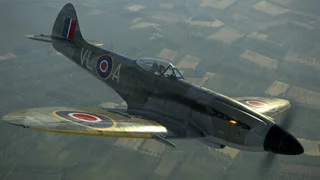
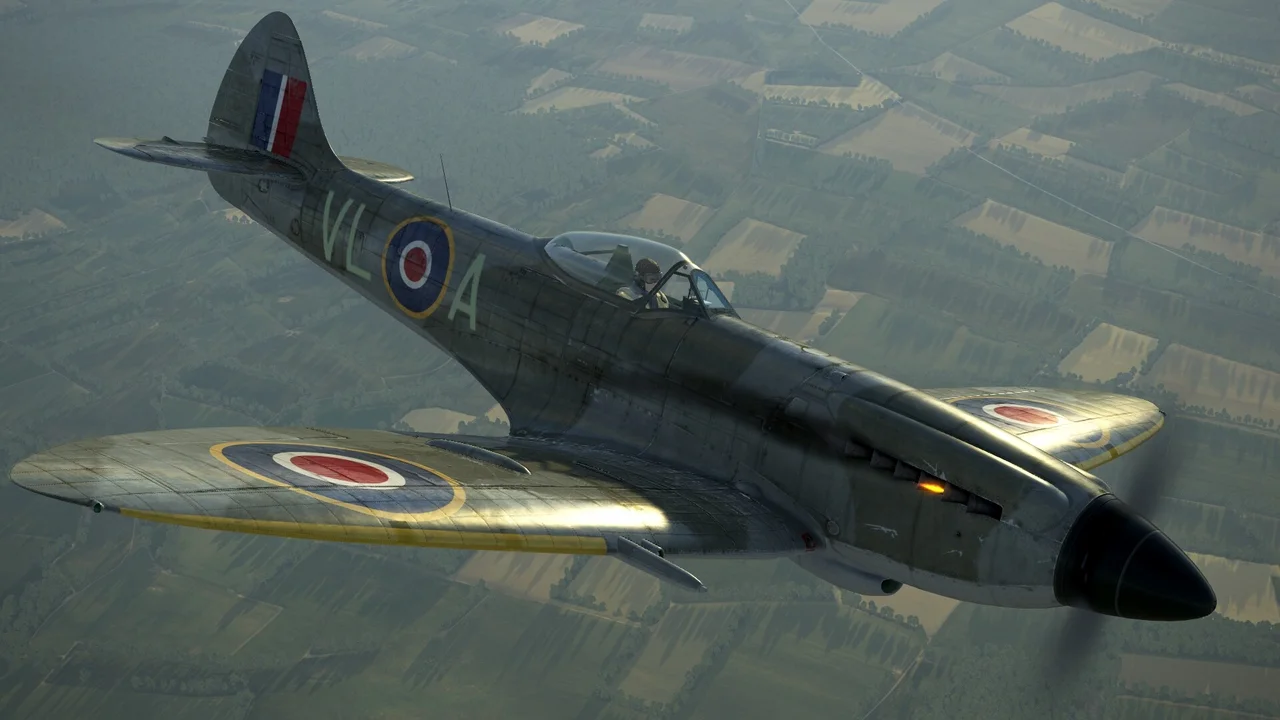
IL-2 Sturmovik: Spitfire Mk.XIVe with Teardrop Canopy adds a Spitfire Mk. XIVe to IL-2 Sturmovik: Battle of Stalingrad. You can fly it in Quick Mission Builder, Advanced Quick Mission Generator and Multiplayer, as well as in Career mode during the Battle of Bodenplatte timeframe.
The aircraft
The Mk. XIV entered service at the end of 1943 with a high-back rear fuselage that restricted rearward visibility. A version with a cut-down rear fuselage and tear-drop canopy began development and production at the end of 1944. These aircraft had full-span wings and the same Griffon engine as the original Mk. XIV. They entered Royal Air Force 2nd Tactical Air Force service in March 1945 and remained in operational service after the war in Europe ended in May. Mk. XIVs also began shipping to the South-East Asian Theater in June 1945, arriving too late to fight the Japanese.
The aircraft's default armament is two 20 mm Hispano guns, with 150 rounds per gun and a rate of fire of 650 rounds per minute, and two 12.7 mm Browning .50 machine guns, with 250 rounds per gun and a rate of fire of 850 rounds per minute. It can carry 250 lb or 500 lb general-purpose bombs on racks. For reconnaissance, an F.24 camera can be installed behind the cockpit; this requires clipped wings, which were standard on Fighter Reconnaissance Mk. XIVs.
Modifications
Available armaments and modifications include:
- 150 grade fuel, allowing +21 lb boost. Automatic supercharger gear shifting is disabled, and the stages must be switched manually at 11,000 ft; the estimated speed increase at sea level is 20 km/h.
- Two 250 lb G.P. bombs with racks, adding 250 kg and reducing speed by 22 km/h while carried and 11 km/h after release.
- One 500 lb G.P. bomb with a rack, adding 237 kg and reducing speed by 12 km/h while carried and 6 km/h after release.
- MkII* Reflector Gunsight in place of the MkII Gyro Gunsight.
- Clipped wings, reducing weight by 4 kg.
- Rear-view mirror, adding 1 kg and reducing speed by 1 km/h.
- F.24 photo camera behind the cockpit, adding 28 kg; available with clipped wings only.
- Rounded exhaust pipes.
Skins
The aircraft includes these paint schemes and liveries:
- Standard paint scheme with customizable tactical number.
- Temperate paint scheme, British India, 1946, with customizable tactical number.
- J. E. Johnson, No. 125 Wing, April 1945. Awarded the DFC and Bar and DSO and Bar, Johnson was the Commonwealth's top scorer of WWII with 41 confirmed victories and retired in 1966 as an RAF Air Vice-Marshal.
- George Clinton Keefer, No. 125 Wing Commander, Fassberg, Germany, 1945. He was awarded the DFC and Bar and DSO, survived the war and died in 1985.
- Douglas I. Benham, No. 41 Squadron Leader, Eindhoven, Netherlands, Spring 1945.
- “Lazy Lady,” flown by Jim Bernard Prendergast, No. 414 (RCAF) Squadron Leader, Lüneburg, Germany, May 1945.
- Flight Lieutenant Frederick A. O. Gaze, No. 41 Squadron, Kastrup, Denmark, May 1945.
- Flying Officer Eric Gray, No. 41 Squadron, Celle, Germany, May 1st, 1945.
- “Rabbit,” No. 443 Squadron RCAF, Uetersen, Germany, January 1946.
- “Yvonne,” No. 416 Squadron RCAF, Uetersen, Germany, January 1946.
- No. 151 Operational Training Unit, Peshawar or Ambala, British India, 1946.
Flight characteristics
The aircraft is 9.9 m long, has an 11.21 m wingspan and a wing area of 22.48 m². Its empty weight is 3,322 kg, minimum weight with no ammunition and 10% fuel is 3,444.2 kg, and standard weight is 3,906.9 kg. It carries 363.3 kg of fuel (504.6 litres or 111 gallons), and its maximum useful load is 1,052 kg.
Indicated stall speed is 153–173 km/h in flight configuration and 145–164 km/h in takeoff and landing configuration. The stall angle of attack is 19.0° in flight configuration and 16.3° in landing configuration. The dive speed limit is 756 km/h and the maximum load factor is 12.5 G. Takeoff speed is 170–195 km/h, glideslope speed 180–210 km/h, and landing speed 140–160 km/h, at a landing angle of 12.5°.
Maximum true air speed at 2,750 RPM and +18 boost is 566 km/h at sea level, 661 km/h at 4,000 m and 712 km/h at 8,100 m. The service ceiling is 13,400 m. Climb rates at the same RPM and boost are 23.8 m/s at sea level, 23.5 m/s at 2,650 m and 18.2 m/s at 6,750 m. Maximum-performance turns take 18.1 seconds at sea level at 270 km/h IAS, and 21.0 seconds at 3,000 m at 260 km/h IAS. At 3,000 m, flight endurance is 1 hour 45 minutes at 350 km/h IAS.
These figures use the international standard atmosphere. Flight performance ranges account for possible aircraft mass ranges; maximum speeds, climb rates and turn times use standard aircraft mass. Climb rates and turn times are given at 2,750 RPM and +18 boost.
Engine and controls
The Spitfire uses a Griffon 65 engine. Its maximum power is 1,565 HP in Take-off mode at 2,750 RPM and +12 boost in low gear at sea level; 1,520 HP in International power mode at 2,600 RPM and +9 boost in low gear at 4,270 m; and 1,375 HP in International power mode at 2,600 RPM and +9 boost in high gear at 8,070 m. Emergency Max All Out power reaches 2,063 HP at 2,750 RPM and +18 boost in low gear at 2,134 m, and 1,845 HP at the same settings in high gear at 6,400 m.
The available engine power settings are Max Cruising power (unlimited time) at 2,400 RPM and +7 boost, International power (up to 1 hour) at 2,600 RPM and +9 boost, and Emergency Max All Out power (up to 5 minutes) at 2,750 RPM and +18 boost. Rated water temperature at the engine outlet is 105–115°C, with a maximum of 135°C; rated oil temperature at the engine intake is 90°C, with a maximum of 105°C.
The engine has an automatic manifold-pressure governor that operates when the throttle is at one-third or above, automatic mixture control, and a two-stage mechanical supercharger. Supercharger shifting is automatic, though low gear can be selected manually. The propeller governor has two settings: in the aft position it adjusts pitch to maintain optimal RPM for the current throttle; in the forward position it maintains the highest possible constant propeller RPM. Water and oil radiator shutters operate automatically, with a manual mode that opens them fully.
The aircraft has neutral static stability and a highly effective elevator, so it requires careful control with limited stick input. It becomes unstable with landing flaps extended. Elevator and rudder trimmers are fitted. The pneumatic landing-flap actuator only allows the flaps to extend to their maximum position, and speed with flaps extended is limited to 160 mph.
The tail wheel rotates freely and has no lock. Because the landing-gear wheels are close together, takeoff and landing require confident, accurate rudder-pedal inputs. Differential pneumatic wheel brakes share a control lever: while holding the brake lever, pressing the opposite rudder pedal gradually releases that wheel's brake, allowing the aircraft to swing to either side. A siren warns the pilot if the throttle is low while the landing gear is retracted.
The canopy cannot be opened or closed at high speed because of airflow, and has an emergency release for bailouts. The aircraft also has two underwing formation lights. Both gunsights have sliding sun filters. The standard gunsight can be adjusted for target distance and target base. The gyroscopic gunsight calculates the required angular deflection when firing at a target and offers four modes: fixed reticle, fixed and gyro reticle, gyro reticle, and gyro reticle with target range fixed at 150 yards for night use. Correct deflection depends on setting the target range properly: adjust the target base first, then set the range by matching the range-finding reticle's size to the target.
Frequently asked questions
The best price for IL-2 Sturmovik: Battle of Stalingrad IL-2 Sturmovik: Spitfire Mk.XIVe with Teardrop Canopy is $19.99 at Steam. It is the only shop with an offer that activates in your country.
No. IL-2 Sturmovik: Battle of Stalingrad IL-2 Sturmovik: Spitfire Mk.XIVe with Teardrop Canopy is DLC and only works with IL-2 Sturmovik: Battle of Stalingrad.
The minimum requirements for IL-2 Sturmovik: Battle of Stalingrad are: Windows 10, Intel Core i5, 16 GB RAM, 95 GB storage. It runs on Windows only. The recommended specs are in the System requirements section.
Yes. IL-2 Sturmovik: Battle of Stalingrad has multiplayer and a single-player mode. It supports online co-op and online PvP.
No. Valve rates IL-2 Sturmovik: Battle of Stalingrad as Unsupported on the Steam Deck.
Steam lets publishers create keys to sell in other shops. Once you activate a key, the game is yours to keep, just like a store purchase.
Disclaimer: CD keys have an inherent 1–2% average failure rate. Check the shop terms for buyer protection info. Steam offers no buyer protection for keys bought in other shops and doesn't refund them.
Similar games

X-Plane 11
$29.99
1 offer
Combat Wings: Battle of Britain
−88%$0.59
$4.9923 offers
Microsoft Flight Simulator X: Steam Edition
$24.99
2 offers
Project Wingman
−53%$11.72
$24.9915 offers
Ace Combat 7: Skies Unknown
−77%$13.48
$59.9923 offers
Squad 44
−82%$3.47
$19.9924 offers
VTOL VR
−75%$7.43
$29.9912 offers
Battlefield V
$8.67
10 offers
Scramble: Battle of Britain
−46%$15.99
$29.9919 offers
Bomber Crew
−90%$1.55
$15.9926 offers
IL-2 Sturmovik: Cliffs of Dover Blitz
−86%$1.33
$9.9917 offers
European Air War
$9.99
2 offers