

Buy IL-2 Sturmovik: Battle of Stalingrad IL-2 Sturmovik: P-40E-1 Collector Plane PC key
Offers


Screenshots
1 / 11
IL-2 Sturmovik series
About IL-2 Sturmovik: Battle of Stalingrad IL-2 Sturmovik: P-40E-1 Collector Plane
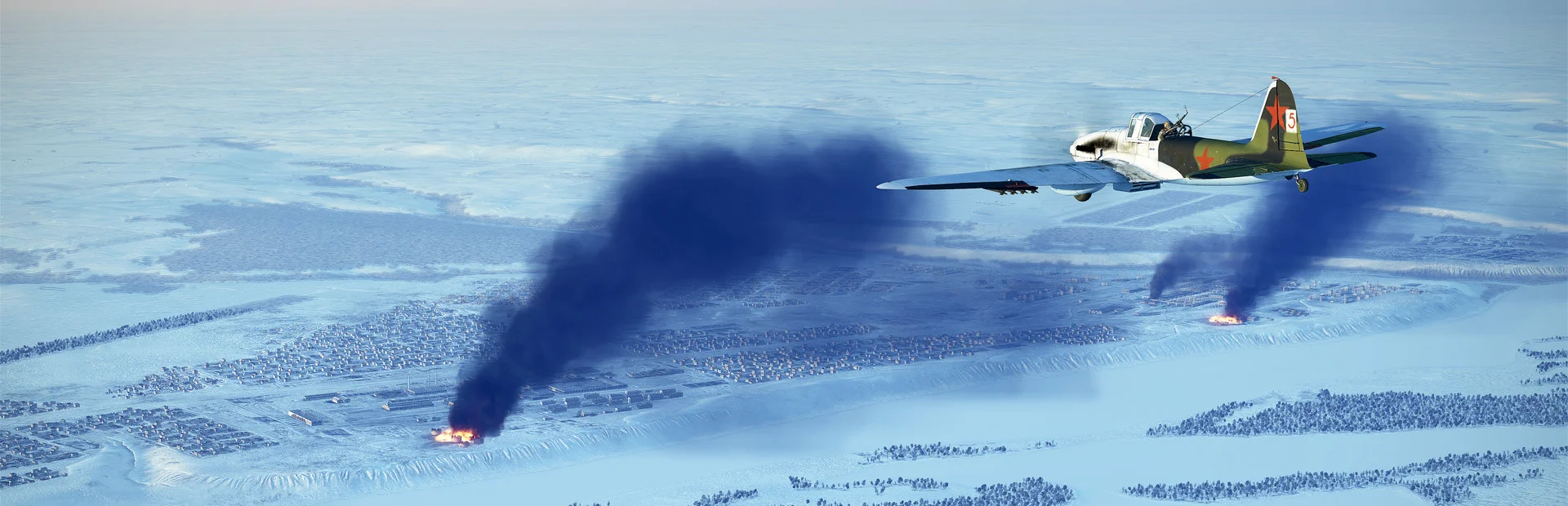
IL-2 Sturmovik: P-40E-1 Collector Plane adds the P-40E to IL-2 Sturmovik: Battle of Stalingrad. You can fly it in Career mode during the Battle of Moscow, Battle of Stalingrad and Battle of Kuban timeframes, as well as in multiplayer and Quick Mission Builder. The aircraft was called the Kittyhawk by the Soviets and British, and the Warhawk by the Americans. The United States produced more P-40s than any other fighter during World War II, and many served with the Soviet Union under the Lend-Lease Act.
The P-40E
The P-40E carries six wing-mounted Browning M2 .50-calibre (12.7 mm) machine guns, each with 235 rounds and a rate of fire of 850 rounds per minute. Its size gives the pilot more room and additional armour protection compared with German and Soviet fighters, but also makes the aircraft a larger target. Its combat debut was in December 1941.
The aircraft is 9.05 m (29.7 ft.) long, has an 11.4 m (37.4 ft.) wingspan and a wing surface of 21.92 sq. m (71.9 sq. ft.).
Modifications
You can equip the P-40E with these modifications:
- Reduced armament: remove two wing-mounted machine guns, saving 156 kg (344 lbs.) and providing a minor speed gain.
- Additional machine-gun ammunition: carry 312 rounds for each inner gun, 291 for each middle gun and 240 for each outer gun, instead of 235 per gun. This adds 207 kg (456 lbs.) and causes a minor speed loss. With only four guns fitted, each can carry 615 rounds.
- ROS-82 rockets: fit four 82 mm high-explosive unguided rockets. They add 40 kg (88 lbs.) and drag that reduces speed by 10–13 kph.
- FAB-250sv bomb: carry one 254 kg general-purpose bomb. The bomb and rack add 264 kg (582 lbs.); speed falls by 19 kph (31 mph) before release and by 7 kph (11 mph) after release.
- FAB-500M bomb: carry one 522 kg general-purpose bomb. The bomb and rack add 532 kg (1,173 lbs.); speed falls by 36 kph (22 mph) before release and by 7 kph (4 mph) after release.
- Rearview mirror: add a mirror for viewing behind the aircraft.
Available skins
The P-40E includes these skins:
- Standard pattern with winter camouflage.
- 191 IAP VVS KBF, Baltic, 1943: “56” in the standard British two-colour pattern, with a white spinner and rudder.
- No.112 Sqn., flown by Sgt Henry Burney and Sqn. Ldr. Clive Caldwell, Libya, March–May 1942: “GA-Y” in the standard British two-colour desert pattern, with a shark mouth.
- Late-style VVS camouflage in dark grey and grey, with a white rudder and stars.
- Default USAAF dark olive drab, overpainted with winter camouflage.
- 1st. American Volunteers Group “Flying Tigers,” China, 1942: “77” in the standard British two-colour pattern, with Chinese markings and Flying Tigers emblems.
- No.14 Sqn. Royal Canadian Air Force, Western Air Command: “Z” in the standard British two-colour pattern, with a shark mouth.
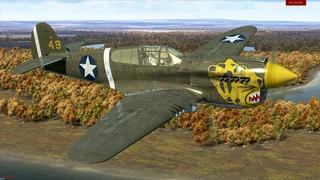
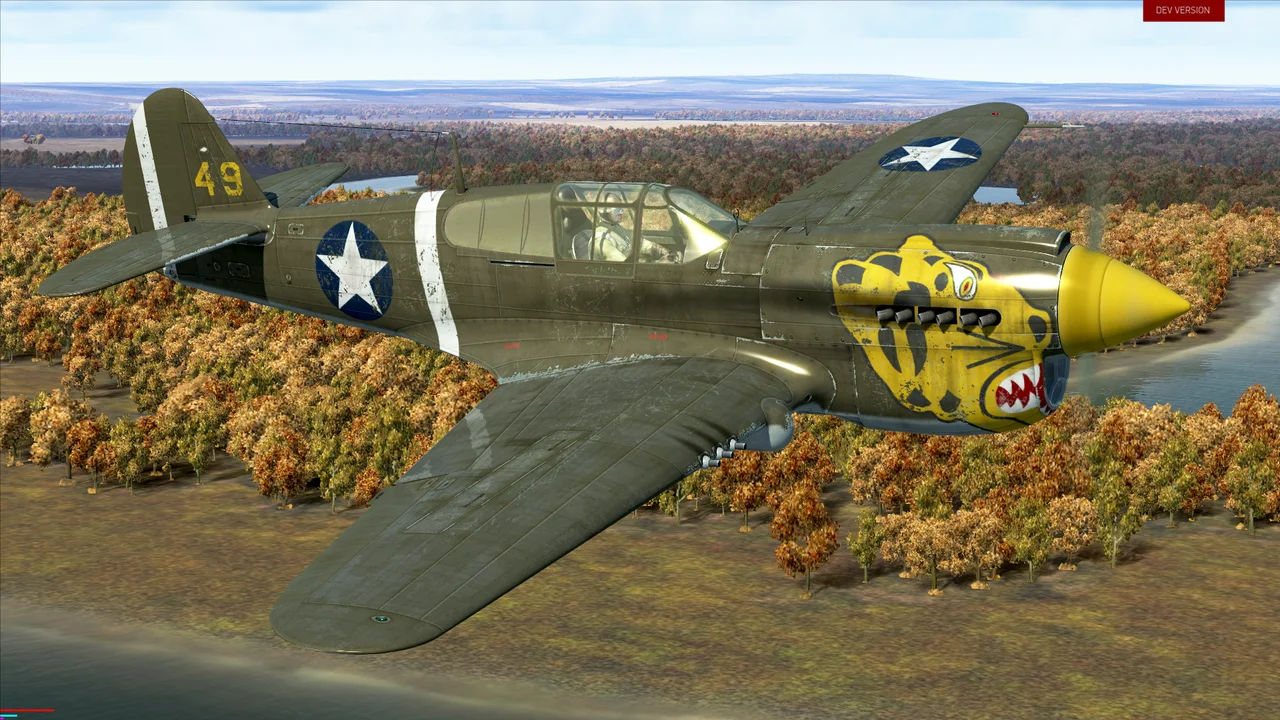
- 11th FS USAAF, Capt. John S. Chennault, Umnak, Aleutian Islands, summer 1942: “49” in default USAAF dark olive drab, with a tiger head.
- 154th IAP, Maj. P.A. Pokryshev, Leningrad area, 1942: “50” in the standard British two-colour pattern, with a white spinner and kill markings.
- 325th FG, CO Lt. Col Robert Baseler, Mateur, Tunisia, September 1943: dark grey with a checkered tail, a red ace of spades on the nose and red ailerons.
Flight performance
Flight figures are given for international standard atmosphere (ISA). Performance ranges reflect possible aircraft mass ranges; maximum speeds, climb rates and turn times use standard aircraft mass. Climb rates are measured at Take-off power, while turn times use Maximum possible power.
- Indicated stall speed: 153–176 km/h in flight configuration and 141–164 km/h in takeoff/landing configuration.
- Dive speed limit: 860 km/h.
- Maximum load factor: 12.2 G.
- Stall angle of attack: 14° in flight configuration and 12.6° in landing configuration.
- Maximum true air speed at sea level: 494 km/h at Take-off power.
- Maximum true air speed at 5,000 m: 601 km/h at Take-off power.
- Service ceiling: 9,200 m.
- Climb rate: 12.5 m/s at sea level, 10 m/s at 3,000 m and 3.7 m/s at 6,000 m.
- Maximum-performance turn: 24.3 seconds at sea level and 36.1 seconds at 3,000 m, both at 270 km/h IAS.
- Flight endurance: 2.8 hours at 3,000 m and 350 km/h IAS.
- Takeoff speed: 160–190 km/h.
- Glideslope speed: 210–220 km/h.
- Landing speed: 140–145 km/h, with a landing angle of 13.9°.
Engine and operation
The P-40E uses a V-1710-39 engine. Its maximum power is 1,470 HP at sea level in Maximum Possible mode, 1,150 HP at sea level in Take-off mode and 900 HP at sea level in Nominal mode. It produces 1,150 HP at 12,000 feet in Combat mode and 1,000 HP at 10,800 feet in Nominal mode.
The engine has no automatic manifold-pressure governor, so manifold pressure changes with throttle position, RPM and altitude and needs to be monitored to avoid engine damage. Its single-stage mechanical supercharger requires no manual control. The automatic fuel-mixture control maintains an optimal mixture with the lever at Auto Rich (66%); Auto Lean (33%) can be selected to reduce fuel consumption, Full Rich (100%) is used if the automatic control malfunctions, and Cut Off (0%) stops the engine. An automatic RPM governor adjusts propeller pitch to maintain the selected RPM; you can also disable it and control propeller pitch manually.
The engine modes are:
- Nominal: unlimited time, 2,600 RPM and 37.2 inches Hg.
- Combat power: up to 5 minutes, 3,000 RPM and 42 inches Hg.
- Take-off power: up to 2 minutes, 3,000 RPM and 45.5 inches Hg.
- Maximum Possible power: 3,000 RPM and 56.0 inches Hg; prohibited by the flight manual.
Water temperature is rated at 105–115 °C, with a maximum of 125 °C. Oil temperature is rated at 70–85 °C, with a maximum of 90 °C. The supercharger has a single gear. The aircraft’s empty weight is 3,073 kg, minimum weight is 3,264.2 kg (no ammunition and 10% fuel), standard weight is 3,819.1 kg and maximum takeoff weight is 4,414 kg. It carries 404 kg (561 l) of fuel and has a useful load of 1,341 kg.
Aircraft controls
The water and oil radiator shutters are linked to the engine cowl outlet shutters and operated manually. The aircraft has a small yaw-stability margin: above 12° of sideslip, it becomes unstable in yaw and the sideslip angle increases on its own. It has pitch, roll and yaw trimmers, and hydraulically operated landing flaps that extend to any angle up to 45°.
The tailwheel unlocks when rudder input exceeds half the pedal range and remains locked below that point, so large rudder inputs should be avoided at high speed. The left and right wheel brakes operate independently through the upper parts of the rudder pedals, and the aircraft also has a parking brake. Three fuel gauges display the levels in the individual tanks. Strong airflow prevents the canopy from opening or closing at high speed, and an emergency release allows it to be jettisoned for a bailout.
The aircraft has a mechanical release for a single bomb. With rockets installed, a salvo controller offers single-fire, two-rocket and four-rocket modes. The gunsight has a sliding sun filter and a backup mechanical sight for use if the main sight is damaged.
Frequently asked questions
The best price for IL-2 Sturmovik: Battle of Stalingrad IL-2 Sturmovik: P-40E-1 Collector Plane is $19.99 at Steam. It is the only shop with an offer that activates in your country.
No. IL-2 Sturmovik: Battle of Stalingrad IL-2 Sturmovik: P-40E-1 Collector Plane is DLC and only works with IL-2 Sturmovik: Battle of Stalingrad.
The minimum requirements for IL-2 Sturmovik: Battle of Stalingrad are: Windows 10, Intel Core i5, 16 GB RAM, 95 GB storage. It runs on Windows only. The recommended specs are in the System requirements section.
Yes. IL-2 Sturmovik: Battle of Stalingrad has multiplayer and a single-player mode. It supports online co-op and online PvP.
No. Valve rates IL-2 Sturmovik: Battle of Stalingrad as Unsupported on the Steam Deck.
Steam lets publishers create keys to sell in other shops. Once you activate a key, the game is yours to keep, just like a store purchase.
Disclaimer: CD keys have an inherent 1–2% average failure rate. Check the shop terms for buyer protection info. Steam offers no buyer protection for keys bought in other shops and doesn't refund them.
Similar games

X-Plane 11
$29.99
1 offer
Combat Wings: Battle of Britain
−88%$0.59
$4.9923 offers
Microsoft Flight Simulator X: Steam Edition
$24.99
2 offers
Project Wingman
−53%$11.72
$24.9915 offers
Ace Combat 7: Skies Unknown
−77%$13.48
$59.9923 offers
Squad 44
−82%$3.47
$19.9924 offers
VTOL VR
−75%$7.43
$29.9912 offers
Battlefield V
$8.67
10 offers
Scramble: Battle of Britain
−46%$15.99
$29.9919 offers
Bomber Crew
−90%$1.55
$15.9926 offers
IL-2 Sturmovik: Cliffs of Dover Blitz
−86%$1.33
$9.9917 offers
European Air War
$9.99
2 offers