

Buy IL-2 Sturmovik: Battle of Stalingrad IL-2 Sturmovik: P-38J-25 Collector Plane PC key
Offers


Screenshots
1 / 9
IL-2 Sturmovik series
About IL-2 Sturmovik: Battle of Stalingrad IL-2 Sturmovik: P-38J-25 Collector Plane
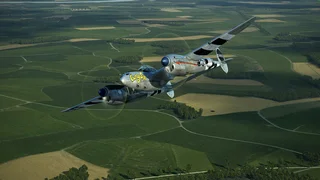
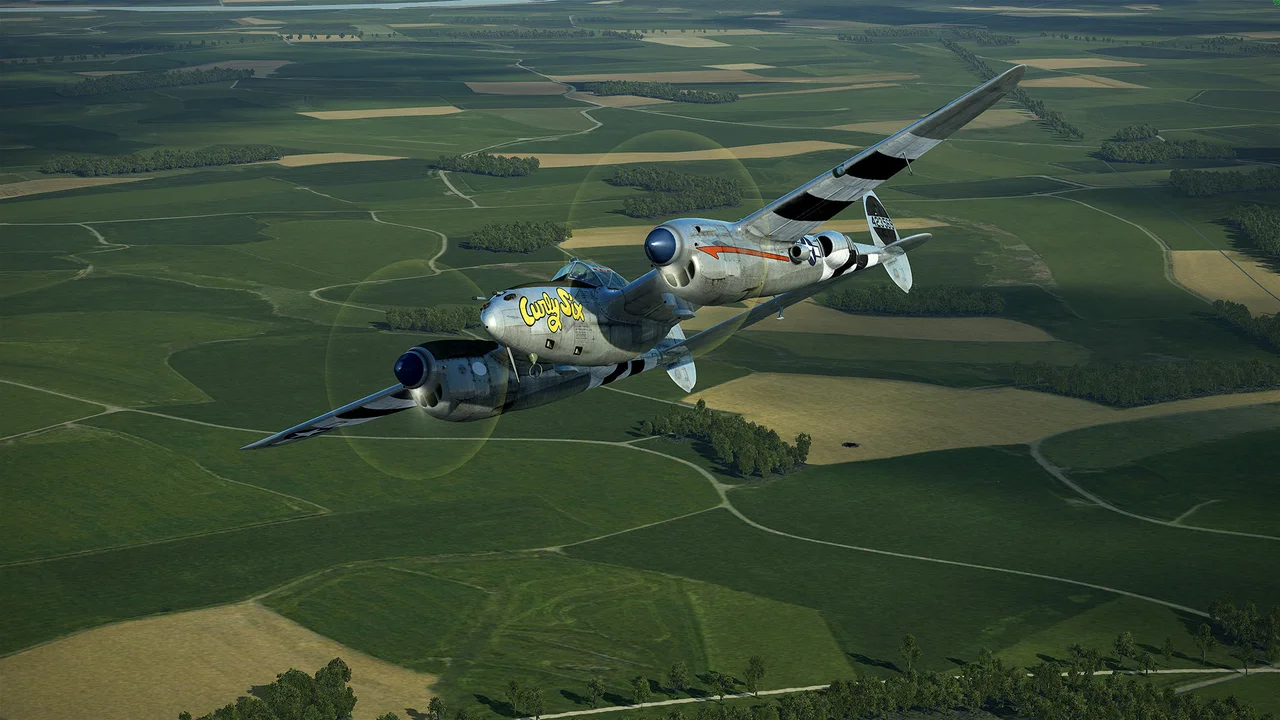
The P-38J-25 is a late-model P-38 Lightning flown by the USAAF in Europe and the Pacific. Its twin-boom layout houses the engines, superchargers and landing gear, while the center section contains the nose gear, cockpit and guns. The J-25 adds dive flaps that can be deployed quickly to help address the high-speed dive instability of earlier models. The P-38, sometimes called the “Fork Tailed Devil,” served on all fronts involving the United States during the war as a bomber escort, interceptor and, later, ground-attack aircraft.
Armament and missions
The default armament is a 20mm M2 gun with 150 rounds and four 12.7mm M2 .50 machine guns with 300 rounds each. The gun fires at 650 rounds per minute and the machine guns at 850 rounds per minute. The aircraft can carry bombs or drop tanks and has excellent range; its available modifications add machine-gun ammunition, bombs, rockets or a radio compass for navigation using radio beacons.
You can fly the P-38J-25 in Quick Mission Builder and Multiplayer modes, as well as in Career mode during the Battle of Bodenplatte timeframe. Its combat debut was in 1944.
Modifications
The available options include:
- Additional machine-gun ammunition: 500 rounds for each gun, adding 99.3 kg (218.9 lbs).
- Two 500 lb General Purpose Bombs M64: adds 508 kg (1120 lbs) with racks; speed loss is 9 kph (5.5 mph), then 2 kph (1.2 mph) after release.
- Two 1000 lb General Purpose Bombs M65: adds 1024 kg (2324 lbs) with racks; speed loss is 19 kph (11.6 mph), then 2 kph (1.2 mph) after release.
- Two 2000 lb General Purpose Bombs M66: adds 1858 kg (4096 lbs) with racks; speed loss is 23 kph (14.2 mph), then 2 kph (1.2 mph) after release.
- Six 500 lb General Purpose Bombs M64 on underwing bomb holders: adds 1568 kg (3457 lbs); speed loss is 52 kph (32.3 mph), then 14 kph (12.0 mph) after release.
- Four 1000 lb General Purpose Bombs M65 on underwing bomb holders: adds 2092 kg (4612 lbs); speed loss is 60 kph (37.0 mph), then 19 kph (12.0 mph) after release.
- Six M8 rockets in jettisonable M10 launchers: adds 171.9 kg (379 lbs) with launchers; speed loss is 18 kph (11.4 mph), then 13 kph (8.2 mph) after firing and 4 kph (2.5 mph) after jettisoning the launchers.
- Bendix MN-26 fixed loop radio compass for navigation with radio beacons: adds 17.5 kg (38.6 lbs).
Aircraft skins
The aircraft includes a standard pattern and 12 named skins:
- “Little Buckaroo”: Major Robert C. “Buck” Rogers, Squadron Commanding Officer, 392nd FS, 367th FG, 9th AF, Peray, France, 1944.
- “Philbert 3”: Major Charles Matheson, Commander of the 394th FS, 367th FG.
- 429th FS: 474th FG, Florennes, Juzaines, March 1945.
- “SCRAPIRON IV”: Captain Lawrence E. “Scrappy” Blumer, 393rd FS, 367th FG, Criquevile, France, late 1944.
- “Arkansas Traveler”: Lt. J. Owen Fincher, 392nd FS, 367th FG, 1945.
- 1Lt. Lawrence P. Liebers: 428th FS, 474th FG, Langensalza, Germany, 1945.
- “Les Vin, Les Femmes, et Les Chansons”: Captain Paul J. Sabo, 485th FS, 370th FG, France, 1944.
- 1Lt. Robert C. “Swat” Milliken: 429th FS, 474th FG, Florennes, Belgium, October 1944.
- “YIPPEE”: the 5000th P-38 built, piloted by Milo Burcham in Southern California, May 1944.
- “Curly Six”: Major Jack L. Reed, 394th FS, 367th FG.
- “Hey Stuff”: 1Lt. W.T. Estabrook, 394th FS, 367th FG.
- “SanDot IV”: 458th FS, 370th FG, late 1944.
- “California Cutie”: Lt. Richard O. Loehnert, 20th FG, 55th FS, 8th AF, June 1944.
Flight and engines
The P-38J-25 is 10.89 m (35.73 feet) long, has a 15.85 m (52 feet) wingspan and a wing surface of 30.4 m² (327 feet²). Its empty weight is 6356 kg (14013 lb), standard weight is 7890 kg (17395 lb), and maximum takeoff weight is 10113 kg (22295 lb). It carries 1132 kg (2496 lb), or 1575 l (416 gal), of fuel and has a useful load of 3757 kg (8282 lb).
The aircraft is powered by left and right Allison V-1710-89 and V-1710-91 engines. Each has an automatic single-stage supercharger and an automatic turbo-supercharger, driven by engine exhaust backpressure and regulated through the pilot’s throttle control and exhaust shutters. Turbo-supercharger speed changes gradually rather than immediately when the throttle is adjusted; for takeoff, the brakes must be held for several seconds after moving the throttle to the takeoff position, until the turbo-supercharger reaches 54 inches of pressure.
The engines produce up to 1550 HP in WEP mode at sea level and 1505 HP at 7860 m (25800 feet). Cruise power is unlimited at 2600 RPM and 44 inch Hg; combat power is available for up to 15 minutes at 3000 RPM and 54 inch Hg; and WEP is available for up to 5 minutes at 3000 RPM and 60 inch Hg. Maximum continuous turbocharger speed is 24000 RPM, rising to 26400 RPM for up to 15 minutes. Rated and maximum water temperatures at the engine output are 85 °C and 105 °C; oil temperatures are 105 °C and 115 °C. The supercharger has a single gear.
Flight controls and systems
Automatic mixture control maintains the optimal mixture with the lever at Auto Rich (70%). Auto Lean (30%) enables automatic leaning to reduce fuel consumption; if the automatic mixture control malfunctions, the lever should be moved fully forward to Full Rich. Idle Cut Off (0%) stops the engine. An automatic engine governor maintains the selected RPM by adjusting propeller pitch through an electric actuator, which can be switched off for manual pitch control; the propellers can also be feathered.
The aircraft has pitch and yaw trimmers. Hydraulic landing flaps can extend to any angle up to 40°, and a short press of the maneuver-flaps control sets a fixed maneuver position. Hydraulic aileron actuators support roll performance at high speed. The aircraft also has independent hydraulic controls for the left and right wheel brakes, operated by pressing the upper part of the rudder pedal, and a parking brake.
A landing-gear indicator lights when the gear is neither fully extended nor retracted. You can also check the nose wheel’s extension in mirrors on the inner sides of the engine nacelles, or observe the hydraulic pressure drop as the landing gear operates. Warning lamps indicate low fuel in the outer wing tanks, the primary fuel source, and separate indicators show the fuel levels in the left and right tank pairs. The canopy has an emergency release for bailouts; its side windows can be lowered in flight, though doing so can cause excessive shaking.
An electric bomb controller can release bombs one at a time from the left and right racks or in pairs. The rocket controller supports single, pair, triple and salvo launches; in a salvo, all rockets fire at 0.1-second intervals. Rocket containers can be jettisoned.
Performance figures
The figures below use the international standard atmosphere. Flight-performance ranges reflect possible aircraft mass ranges; maximum speeds, climb rates and turn times are for standard aircraft mass with 70% fuel, and turn times use WEP power.
- Indicated stall speed in flight configuration: 179–220 km/h (111–137 mph).
- Indicated stall speed in takeoff/landing configuration: 149–185 km/h (93–115 mph).
- Dive speed limit: 725 km/h (450 mph); maximum load factor: 9.0 G.
- Stall angle of attack: 14.1° in flight configuration and 11.5° in landing configuration.
- Maximum true airspeed in WEP: 557 km/h (346 mph) at sea level and 674 km/h (419 mph) at 7860 m (25800 feet).
- Maximum true airspeed in combat mode: 540 km/h (336 mph) at sea level and 670 km/h (416 mph) at 8500 m (27890 feet).
- Service ceiling: 12350 m (40500 feet).
- Climb rate in WEP: 20.4 m/s (4020 feet/min) at sea level, 19.1 m/s (3758 feet/min) at 3000 m (9843 feet) and 15.0 m/s (2953 feet/min) at 6000 m (19685 feet).
- Climb rate in combat mode: 12.8 m/s (2518 feet/min) at sea level, 11.5 m/s (2258 feet/min) at 3000 m (9843 feet) and 9.4 m/s (1844 feet/min) at 6000 m (19685 feet).
- Maximum-performance turn time: 20.0 seconds at sea level and 310 km/h (195 mph) IAS; 28.3 seconds at 3000 m (9843 feet) and 320 km/h (200 mph) IAS.
- Flight endurance at 3000 m (9843 feet): 5.8 hours at 350 km/h (217 mph) IAS.
- Takeoff speed: 160–175 km/h (100–110 mph); glideslope speed: 185–210 km/h (115–130 mph).
- Landing speed: 150–175 km/h (95–110 mph); landing angle: 7.0°.
Frequently asked questions
The best price for IL-2 Sturmovik: Battle of Stalingrad IL-2 Sturmovik: P-38J-25 Collector Plane is $19.99 at Steam. It is the only shop with an offer that activates in your country.
No. IL-2 Sturmovik: Battle of Stalingrad IL-2 Sturmovik: P-38J-25 Collector Plane is DLC and only works with IL-2 Sturmovik: Battle of Stalingrad.
The minimum requirements for IL-2 Sturmovik: Battle of Stalingrad are: Windows 10, Intel Core i5, 16 GB RAM, 95 GB storage. It runs on Windows only. The recommended specs are in the System requirements section.
Yes. IL-2 Sturmovik: Battle of Stalingrad has multiplayer and a single-player mode. It supports online co-op and online PvP.
No. Valve rates IL-2 Sturmovik: Battle of Stalingrad as Unsupported on the Steam Deck.
Steam lets publishers create keys to sell in other shops. Once you activate a key, the game is yours to keep, just like a store purchase.
Disclaimer: CD keys have an inherent 1–2% average failure rate. Check the shop terms for buyer protection info. Steam offers no buyer protection for keys bought in other shops and doesn't refund them.
Similar games

X-Plane 11
$29.99
1 offer
Combat Wings: Battle of Britain
−88%$0.59
$4.9923 offers
Microsoft Flight Simulator X: Steam Edition
$24.99
2 offers
Project Wingman
−53%$11.72
$24.9915 offers

Ace Combat 7: Skies Unknown
−77%$13.48
$59.9923 offers
Squad 44
−82%$3.47
$19.9924 offers
VTOL VR
−75%$7.43
$29.9912 offers

Battlefield V
$8.67
10 offers
Scramble: Battle of Britain
−46%$15.99
$29.9919 offers

Bomber Crew
−90%$1.55
$15.9926 offers
IL-2 Sturmovik: Cliffs of Dover Blitz
−86%$1.33
$9.9917 offers
European Air War
$9.99
2 offers