

Buy IL-2 Sturmovik: Battle of Stalingrad IL-2 Sturmovik: MC.202 Series VIII Collector Plane PC key
Offers


Screenshots
1 / 11
IL-2 Sturmovik series
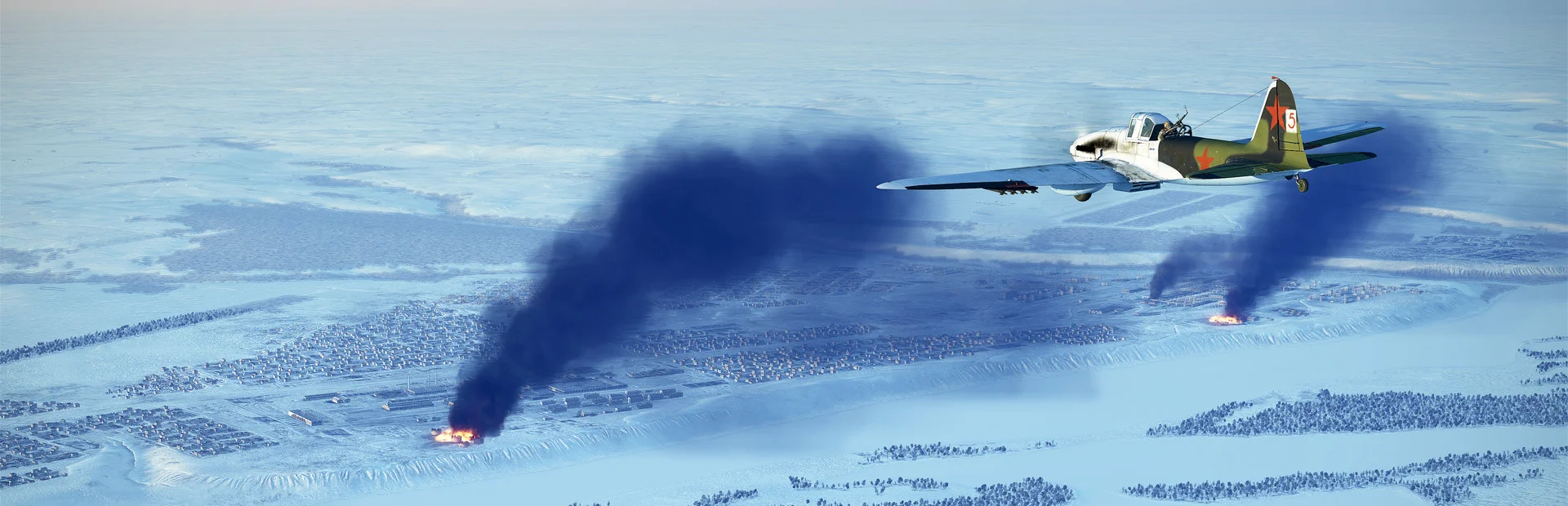
About IL-2 Sturmovik: Battle of Stalingrad IL-2 Sturmovik: MC.202 Series VIII Collector Plane
IL-2 Sturmovik: MC.202 Series VIII Collector Plane adds the Italian Macchi 202 fighter to IL-2 Sturmovik: Battle of Stalingrad. You can fly it in Career mode during the Battle of Moscow and Battle of Stalingrad timeframes, in multiplayer, and in Quick Mission Builder. The aircraft entered combat in June 1942.
Aircraft design
The Macchi combines a moderate size comparable to German Messerschmitts with the robustness of a Focke-Wulf. Its airframe is made of metal, with a tough framework and two-spar wings; the rudder is the exception. The left wing is 20 cm longer than the right to counter engine torque. The wings have no leading-edge slats, and the wide, serviceable landing gear is generally similar to that of the FW-190. The aircraft has an elevator trim stabilizer but no trim tabs on other flight surfaces; ground personnel can set its bendable trim tabs before flight.
The airframe is aerodynamically clean and well designed, though the radiator cowlings cause drag. The aircraft has a manually controlled horizontal stabilizer, which should be set to neutral before takeoff and landing and can be used to trim the flight stick in flight. In a deep dive, the stabilizer should be set so you have to push the stick forward to maintain the dive angle.
Engine and controls
The RA.1000 engine is an export version of the DB601A, also used in earlier Bf-109 models. Its automatic mixture control and fluid-coupling supercharger need no manual adjustment. The engine has an automatic propeller governor with fixed settings of 2200 RPM for nominal operation and 2400 RPM for combat power; you can switch off the governor and control propeller pitch manually. The propeller has two basic positions, 2200 and 2400 RPM, while other settings require manual pitch control. Water and oil radiator shutters are also controlled manually, and the throttle works in reverse: move it backward for full throttle and forward for idle.
Nominal power is unlimited at 2200 RPM and 1.23 ata. Combat power is available for up to 5 minutes at 2400 RPM and 1.35 ata; boosted power lasts up to 1 minute at 2500 RPM and 1.45 ata. Maximum engine power is 1175 HP in boosted mode at sea level, 1050 HP in combat mode at sea level, and 1100 HP in combat mode at 3700 m.
The landing flaps use a hydraulic actuator and can be extended to any angle up to 45°. A pneumatic spring lets airflow push them upward at speeds above 200 km/h. The tail wheel has a manual lock, which should be engaged for long straight taxiing and before takeoff and landing. Differential pneumatic wheel brakes share a control lever: while the lever is held, applying the rudder gradually releases the brake on the opposite wheel, turning the aircraft.
The fuel gauge shows only the front tank's level. The canopy cannot be opened in flight and should be closed before takeoff; it has an emergency release for bailouts. Bombs can only be released one at a time. The gunsight has a sliding sun filter and a folding mechanical backup sight for use if the main sight is damaged.
Armament and modifications
The standard armament is two 12.7 mm Breda SAFAT machine guns, each setup having 400 rounds and a rate of fire of 700 rounds per minute. The available modifications are:
- Armored windscreen: an armored triplex windscreen that adds 10 kg (22 lb).
- Wing machine guns: two 7.7 mm Breda SAFAT guns with 500 rounds each; the added weight is 25–49 kg (55–108 lb).
- Gun pods: two wing-mounted MG 151/20 20 mm guns with 135 rounds each; the added weight is 157–212 kg (346–467 lb), and speed falls by 15 kph (24 mph).
- Two 50-T general-purpose bombs: with racks, these add 130 kg (287 lb); speed falls by 14 kph (9 mph) while carrying them and by 7 kph (4 mph) after release.
- Two 100-T general-purpose bombs: with racks, these add 220 kg (485 lb); speed falls by 20 kph (12 mph) while carrying them and by 7 kph (4 mph) after release.
Skins
The aircraft includes these paint schemes:
- Standard pattern with winter camouflage.
- 2./JG 108, '214', with Luftwaffe markings, used in a training unit.
- 73°Squadriglia, 9°Gruppo, 4°Stormo C.T., Tenente Giulio Reiner, Fuka, Egypt, July 1942: '73-7', dark olive green with sand blotches and a light grey underside.
- 386a°Squadriglia, 21°Gruppo Autonomo C.T., Kantemirowka, USSR, October 1942: '386-1', light brown with dark green patches and light grey undersides.
- 70°Squadriglia, 23°Gruppo, 3°Stormo C.T., Cerveteri, Italy, August 1943: '2-70', light brown with intensive dark green patches and light grey undersides.
- 71°a Squadriglia, 17°Gruppo, 1°Stormo C.T., Udine-Campoformido, Italy, October 1941: '71-2', dark olive green with light grey undersides.
- 369°a Squadriglia, 22°Gruppo, 53°Stormo C.T., Capodichino, Italy, Summer 1943: '369-12', light brown with dark green rings and light grey undersides.
- 378°a Squadriglia, 155°Gruppo, 51°Stormo C.T., Gela, Italy, August 1943: '378-4', dark green with yellow and brown patches and light grey undersides.
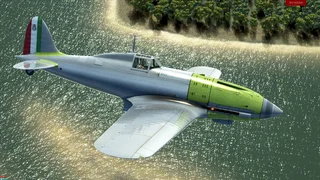
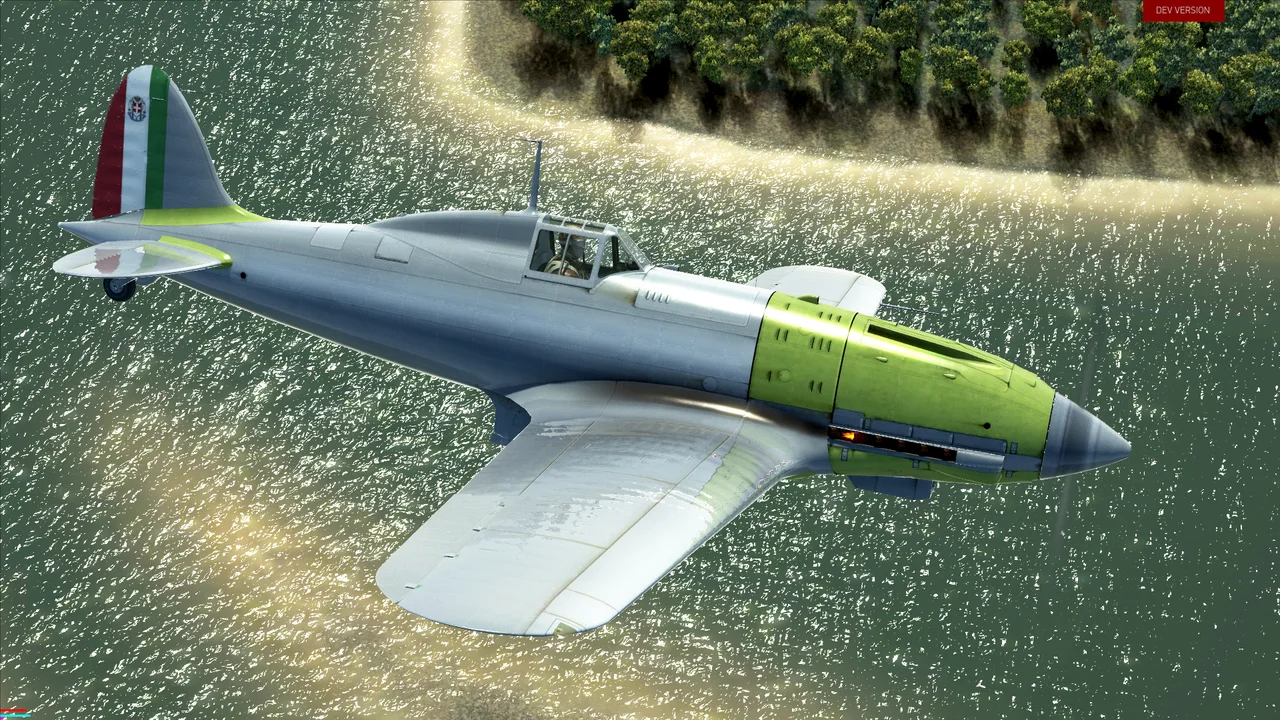
- The Aeromacchi C.202 prototype, first flown at Lonate Pozollo on August 10, 1940, by chief test pilot Guido Carestiato: unpainted metal with some parts in protective primer.
- 2./Jagd Lehrer Überprüfungsgruppe, Konrad Augner: '13', light brown with dark green patches, light grey undersides and yellow markings.
Flight performance
The aircraft's indicated stall speed is 151–166 km/h in flight configuration and 139–152 km/h in takeoff or landing configuration. Its dive speed limit is 850 km/h, maximum load factor is 14.8 G, and stall angle of attack is 19.6° in flight configuration or 17.4° in landing configuration. Maximum true air speed in combat mode is 500 km/h at sea level, 543 km/h at 2000 m and 604 km/h at 5000 m. Service ceiling is 11,300 m.
Climb rates in combat power are 17.3 m/s at sea level, 15.1 m/s at 3000 m and 10.6 m/s at 6000 m. Maximum performance turns in boosted power take 22.6 seconds at sea level and 28.2 seconds at 3000 m, both at 270 km/h IAS. At 3000 m, flight endurance is 2.2 hours at 350 km/h IAS. Takeoff speed is 160–190 km/h, glideslope speed is 190–200 km/h, and landing speed is 140–150 km/h at a landing angle of 13.9°.
These figures use the international standard atmosphere. Flight performance ranges account for possible aircraft mass ranges; maximum speeds, climb rates and turn times use standard aircraft mass. Climb rates are given for combat power, while turn times are given for boosted power.
Engine and aircraft figures
Water temperature is rated at 70–80°C at the engine intake and 94°C at the output, with a maximum output temperature of 100°C. Oil temperature is rated at 60–75°C at the intake, with a maximum of 85°C; at the output it is rated at 90–100°C, with a maximum of 110°C. The supercharger gear shift altitude uses a fluid coupling.
The aircraft is 8.85 m (29.03 ft) long, has a wingspan of 10.58 m (34.7 ft) and a wing area of 16.8 sq. m (55.11 sq. ft). Its empty weight is 2448 kg; minimum weight, with no ammunition and 10%25 fuel, is 2622 kg; standard weight is 2967 kg; and maximum takeoff weight is 3197 kg. Fuel load is 307 kg / 430 l, and useful load is 749 kg.
Frequently asked questions
The best price for IL-2 Sturmovik: Battle of Stalingrad IL-2 Sturmovik: MC.202 Series VIII Collector Plane is $19.99 at Steam. It is the only shop with an offer that activates in your country.
No. IL-2 Sturmovik: Battle of Stalingrad IL-2 Sturmovik: MC.202 Series VIII Collector Plane is DLC and only works with IL-2 Sturmovik: Battle of Stalingrad.
The minimum requirements for IL-2 Sturmovik: Battle of Stalingrad are: Windows 10, Intel Core i5, 16 GB RAM, 95 GB storage. It runs on Windows only. The recommended specs are in the System requirements section.
Yes. IL-2 Sturmovik: Battle of Stalingrad has multiplayer and a single-player mode. It supports online co-op and online PvP.
No. Valve rates IL-2 Sturmovik: Battle of Stalingrad as Unsupported on the Steam Deck.
Steam lets publishers create keys to sell in other shops. Once you activate a key, the game is yours to keep, just like a store purchase.
Disclaimer: CD keys have an inherent 1–2% average failure rate. Check the shop terms for buyer protection info. Steam offers no buyer protection for keys bought in other shops and doesn't refund them.
Similar games

X-Plane 11
$29.99
1 offer
Combat Wings: Battle of Britain
−88%$0.59
$4.9923 offers
Microsoft Flight Simulator X: Steam Edition
$24.99
2 offers
Project Wingman
−53%$11.72
$24.9915 offers

Ace Combat 7: Skies Unknown
−77%$13.48
$59.9923 offers
Squad 44
−82%$3.47
$19.9924 offers
VTOL VR
−75%$7.43
$29.9912 offers

Battlefield V
$8.67
10 offers
Scramble: Battle of Britain
−46%$15.99
$29.9919 offers

Bomber Crew
−90%$1.55
$15.9926 offers
IL-2 Sturmovik: Cliffs of Dover Blitz
−86%$1.33
$9.9917 offers
European Air War
$9.99
2 offers