

Buy IL-2 Sturmovik: Battle of Stalingrad IL-2 Sturmovik: La-5FN series 2 Collector Plane PC key
Offers


Screenshots
1 / 20
IL-2 Sturmovik series
About IL-2 Sturmovik: Battle of Stalingrad IL-2 Sturmovik: La-5FN series 2 Collector Plane
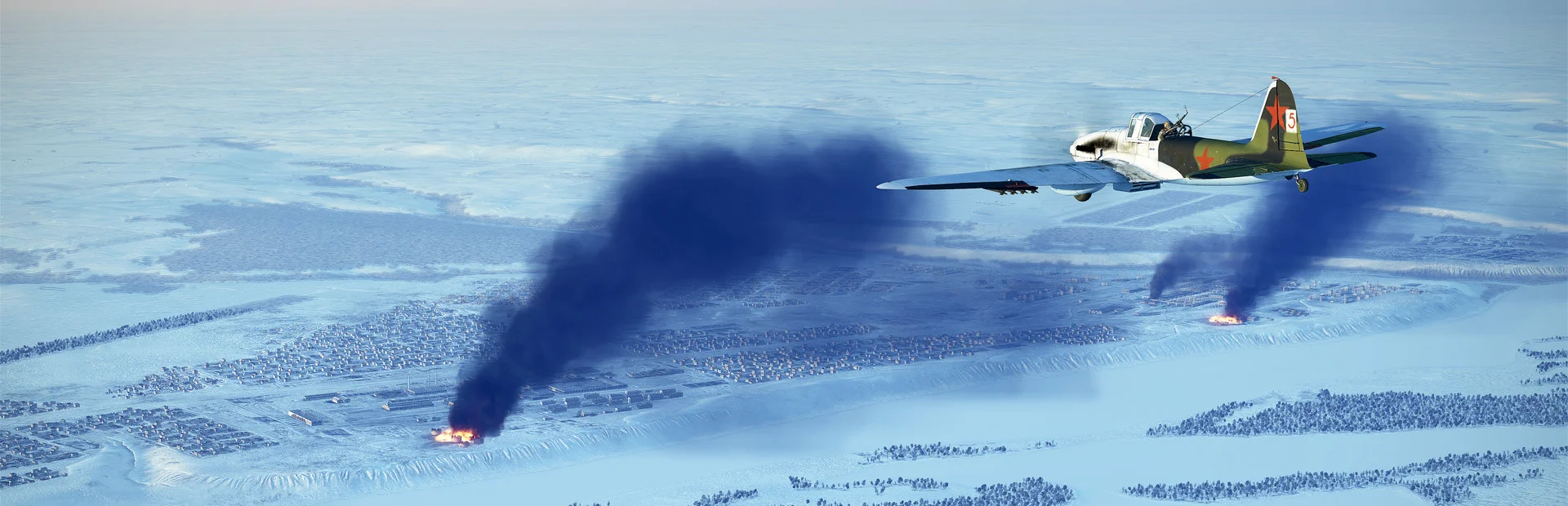
IL-2 Sturmovik: La-5FN series 2 Collector Plane adds the La-5FN series 2 fighter to IL-2 Sturmovik: Battle of Stalingrad. You can fly it in Quick Mission Builder and Multiplayer, and in Career mode during the Battle of Kuban timeframe.
The La-5FN
The La-5FN entered front-line service in the central part of the Eastern Front in Summer 1943 and contributed to the fight for air superiority. Its boosted M-82FN engine uses direct fuel injection and produces 1,850 HP in boosted mode, 180 HP more than the previous engine. Aerodynamic changes include a bubble canopy and lowered rear fuselage, and armored glass protects the pilot’s head from the front and rear.
The aircraft served with many Soviet air regiments and was flown by well-known pilots, including Ivan Kozhedub, the most successful Allied ace and a triple Hero of the Soviet Union. Its combat debut was in June 1943.
Armament and modifications
The default armament is two 20 mm SsVAK guns, each with 170 rounds and a rate of fire of 800 rounds per minute. Loadout variants use either armor-piercing (AP) or high-explosive (HE) rounds only. Available modifications include:
- Two FAB-50sv 50 kg general-purpose bombs; the racks add 120 kg and reduce speed by 20 kph, with a further 12 kph loss after release.
- Two FAB-100M 104 kg general-purpose bombs; the racks add 228 kg and reduce speed by 27 kph, with a further 12 kph loss after release.
- A landing light for night flights, adding 2 kg with a minor speed loss.
- An RPK-10 fixed-loop radio compass, adding 10 kg with a minor speed loss.
- A rearview mirror, adding 1 kg with a minor speed loss.
Paint schemes
The aircraft includes a standard early paint scheme, along with a standard NKAP-43 camouflage scheme for La-5FNs produced from the end of Summer 1943 onward. Other skins depict specific aircraft, pilots and units:
- La-5FN number 57 of the 1st squadron of 32 GIAP, one of the first 12 La-5FNs, during its Summer 1943 front-line test in the northern part of the Kursk Bulge.
- Number 25, flown by Guards Captain Mayorov of 2 GIAP on the 1st Baltic Front in Autumn and Winter 1943–44. Twelve new La-5FNs donated by Mongolian workers arrived at 2 GIAP on September 25, 1943; this aircraft bears the inscription “Mongolian Arat” and a red-orange front engine hood.
- Number 76, Ivan Vishnyakov’s aircraft in 171 IAP in Summer 1944. Its white stars represent his personal combat score from June 6 to July 19, 1944, and it carries standard NKAP-43 camouflage. According to memoirs, “For Oleg Koshevoy” was painted on all aircraft in Vishnyakov’s squadron.
- Number 15, Anatoly Ruzin’s aircraft on the Leningrad Front in Summer 1944. “For Vasjok and Zhora” commemorates Lieutenant Vasily “Vasjok” Grechka, commander of the 2nd Squadron of 159 IAP, and Lieutenant Andrey “Zhora” Vasilyev, who were both killed on June 28, 1944, fighting Fw190As of II./JG54 over Vyborg/Viipuri on the Karelian isthmus.
- Number 71 of 254 IAP, flown by Constantine Nazimov on the 2nd and 3rd Baltic Fronts in Autumn 1944. Its 21 stars represent his overall combat score, and it bears a picture of an eagle carrying a bloodied Hitler.
- Board number 07, Yuri Lyubenyuk’s La-5FN in 813 IAP on the 2nd Belorussian Front in Spring 1945.
- Board number 13, flown by Lieutenant Pavel Kocfelda during the Slovak National Uprising in September–October 1944 from Tri Duby airfield. It was written off after an emergency landing on October 11, 1944. Two victories were recorded in the aircraft: half a Ju-87 for ppor. P. Kocfelda on October 7, and half an FW-189 for ppor. L. Šrom on October 8.
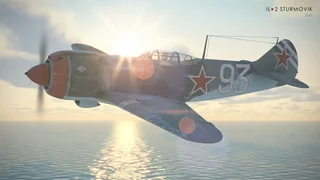
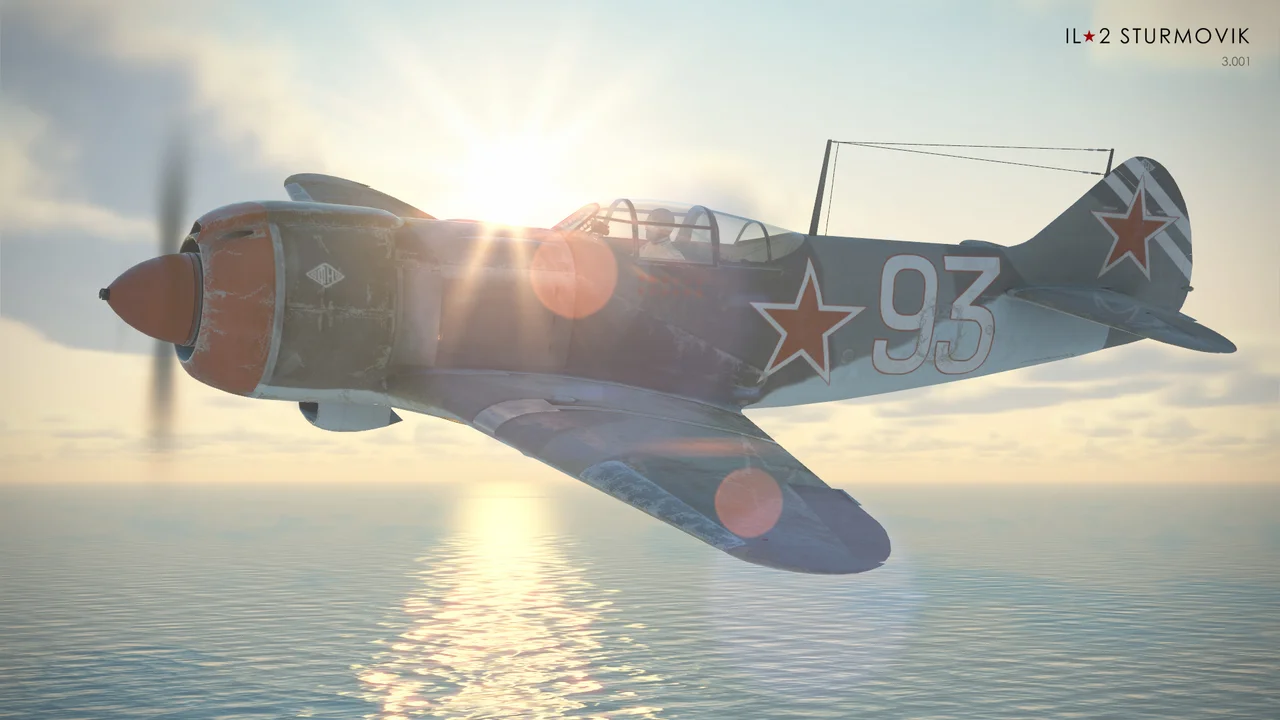
- Board number 93, Vladimir Orekhov’s aircraft on the Bryansk Front in Autumn 1943.
- Board number 101 of 5 GIAP, Vitaly Popkov’s aircraft on the 1st Ukrainian Front in Summer and Autumn 1944. Its 33 victory stars correspond to his personal combat record from August 13, 1944, to February 9, 1945.
- Number 30 of 41 GIAP, Alexander Lobanov’s aircraft on the 1st Ukrainian Front in Summer 1944. “Eagle on top of Elbrus” recalls the fighting in the Caucasus in 1942, while a red heart on the engine hood identifies the regimental commander.
- Board number 14 of 178 GIAP, built with funds donated by worker V. Konev. Ivan Kozhedub flew it in Summer 1944; after he transferred to 176 GIAP, it was assigned to his friend Kirill Evstigneev. Lieutenant P. A. Bryzgalov also flew combat sorties in it.
- Number 69 of 3 GIAP VVS KBF, Ivan Kravtsov’s aircraft in Summer 1944. Its 23 victory stars with white strokes represent his combat score in mid-August 1944.
- Number 25 of 34th IAP air defense, flown by Captain Urvachev in Winter 1944–45. Its six victory asterisks do not match his official score of four personal victories; some victories recorded as personal in his flight book may have been counted as group victories in regimental documents.
- Lieutenant Beketov’s aircraft, built with donations from Kazakh millers in Autumn 1944. After the Battle of Visla at the end of the year, 721 IAP transferred this and its other La-5FNs to 165 IAP before going to the rear to receive the La-7.
- Number 44, flown by Captain Trefilov on the 3rd Belorussian Front in Autumn 1944. The arrow on the fuselage served as a rapid identification marking for fighter aircraft in 303 IAD.
Flight characteristics
The La-5FN is 8.672 m long, has a wingspan of 9.8 m and a wing area of 17.51 m². Its M-82FN engine produces 1,850 HP in boosted mode at sea level, 1,560 HP in nominal mode at sea level, 1,630 HP in nominal mode at 1,550 m and 1,460 HP in nominal mode at 4,800 m. Nominal mode is unlimited; boosted power can be used for up to 10 minutes. Boosted mode uses 2,500 RPM and 1,180 mm Hg, while nominal mode uses 2,400 RPM and 1,000 mm Hg.
At sea level, maximum true air speed is 552 km/h in nominal mode and 583 km/h in boosted mode. Nominal maximum speed is 605 km/h at 2,500 m and 646 km/h at 6,000 m. The service ceiling is 10,500 m. Climb rates are 20 m/s at sea level, 16.7 m/s at 3,000 m and 12.5 m/s at 6,000 m. Maximum-performance turns take 21 seconds at sea level at 320 km/h IAS and 28 seconds at 3,000 m at 340 km/h IAS. At 3,000 m, endurance is 2 hours at 350 km/h IAS.
Indicated stall speed is 168–185 km/h in flight configuration and 147–159 km/h in takeoff and landing configuration. Stall angle of attack is 22.2° in flight configuration and 15.0° in landing configuration. The dive speed limit is 720 km/h, and the maximum load factor is 10 G. Takeoff speed is 175–195 km/h, glideslope speed is 200–210 km/h, and landing speed is 150–160 km/h, at a landing angle of 13°.
The figures use the international standard atmosphere. Flight-performance ranges reflect possible aircraft mass ranges; maximum speeds, climb rates and turn times use standard aircraft mass, and climb rates and turn times are given for boosted power. Empty weight is 2,655 kg, minimum weight with no ammunition and 10% fuel is 2,929 kg, standard weight is 3,305 kg and maximum takeoff weight is 3,544 kg. Fuel load is 334 kg (464 l), and useful load is 896 kg.
Engine and controls
The two-stage mechanical supercharger must be switched manually at 3,500 m, and boost works only in first supercharger gear. The engine’s automatic governor controls propeller pitch to maintain the RPM set by the governor control lever. The oil radiator and air-cooling intake and outlet shutters are controlled manually. The air-cooling intake shutters should normally remain open and should be closed only when the engine might overcool, such as during a dive with the throttle at idle.
The aircraft has elevator and rudder trimmers, automatic wing slats that deploy as the angle of attack increases to soften the pre-stall, and hydraulically actuated landing flaps that can extend to any angle up to 60°. Its tail wheel turns freely and cannot be locked, so takeoff and landing require confident, precise rudder-pedal use. Differential pneumatic wheel brakes share a control lever: holding the brake lever while pressing the opposite rudder pedal gradually releases that wheel’s brake and turns the aircraft to one side or the other.
A fuel gauge shows the total fuel remaining. Strong airflow prevents the canopy from opening or closing at high speed, and it has no emergency release, so you must reduce speed before bailing out. The bomb-rack controls release bombs one at a time. Rated oil temperature at the engine intake is 65–75°C, with a maximum of 85°C; cylinder-head temperature is rated at 180–215°C, with a maximum of 250°C.
Frequently asked questions
The best price for IL-2 Sturmovik: Battle of Stalingrad IL-2 Sturmovik: La-5FN series 2 Collector Plane is $19.99 at Steam. It is the only shop with an offer that activates in your country.
No. IL-2 Sturmovik: Battle of Stalingrad IL-2 Sturmovik: La-5FN series 2 Collector Plane is DLC and only works with IL-2 Sturmovik: Battle of Stalingrad.
The minimum requirements for IL-2 Sturmovik: Battle of Stalingrad are: Windows 10, Intel Core i5, 16 GB RAM, 95 GB storage. It runs on Windows only. The recommended specs are in the System requirements section.
Yes. IL-2 Sturmovik: Battle of Stalingrad has multiplayer and a single-player mode. It supports online co-op and online PvP.
No. Valve rates IL-2 Sturmovik: Battle of Stalingrad as Unsupported on the Steam Deck.
Steam lets publishers create keys to sell in other shops. Once you activate a key, the game is yours to keep, just like a store purchase.
Disclaimer: CD keys have an inherent 1–2% average failure rate. Check the shop terms for buyer protection info. Steam offers no buyer protection for keys bought in other shops and doesn't refund them.
Similar games

X-Plane 11
$29.99
1 offer
Combat Wings: Battle of Britain
−88%$0.59
$4.9923 offers
Microsoft Flight Simulator X: Steam Edition
$24.99
2 offers
Project Wingman
−53%$11.72
$24.9915 offers
Ace Combat 7: Skies Unknown
−77%$13.48
$59.9923 offers
Squad 44
−82%$3.47
$19.9924 offers
VTOL VR
−75%$7.43
$29.9912 offers

Battlefield V
$8.67
10 offers
Scramble: Battle of Britain
−46%$15.99
$29.9919 offers

Bomber Crew
−90%$1.55
$15.9926 offers
IL-2 Sturmovik: Cliffs of Dover Blitz
−86%$1.33
$9.9917 offers
European Air War
$9.99
2 offers