

Buy IL-2 Sturmovik: Battle of Stalingrad IL-2 Sturmovik: Fw 190 D-9 Collector Plane PC key
Offers


Screenshots
1 / 15
IL-2 Sturmovik series
About IL-2 Sturmovik: Battle of Stalingrad IL-2 Sturmovik: Fw 190 D-9 Collector Plane
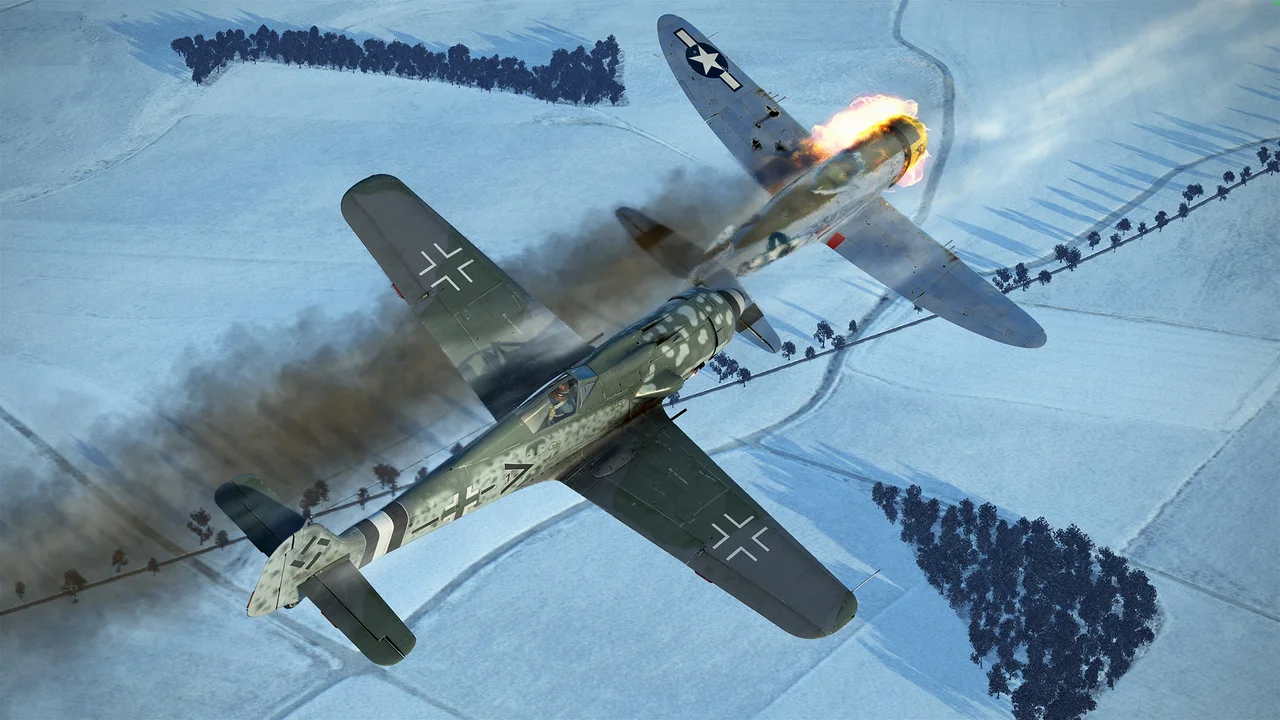
IL-2 Sturmovik: Fw 190 D-9 Collector Plane adds the Fw 190 D-9, known as the “Dora,” to IL-2 Sturmovik: Battle of Stalingrad. You can fly it in Quick Mission Builder and Multiplayer modes, as well as in Career mode during the Battle of Bodenplatte timeframe.
The Fw 190 D-9
Developed as a high-altitude interceptor to counter the Allied air threat on the Western Front, the D-9 began appearing above the front lines in autumn 1944. Its elongated nose houses a liquid-cooled Jumo 213 A-1 engine with MW-50 water-methanol injection, which raises its power to as much as 2,100 HP. The aircraft was initially received coolly by German pilots, but later earned their trust and is considered the best German piston-powered fighter of the late-war period. It was also used to protect Me-262 jets during their vulnerable landing phase, when Allied pilots tried to shoot them down as they landed low on fuel.
The D-9’s default armament consists of two 20mm MG 151/20 guns, with 250 rounds each and a rate of fire of 700 rounds per minute, and two 13mm MG 131 machine guns, with 475 rounds each and a rate of fire of 900 rounds per minute. It is 10.2 m long, has a wingspan of 10.51 m and a wing area of 18.3 m².
Modifications
The aircraft can be equipped with the following modifications:
- Two WGr.21 rockets: mounted in jettisonable launchers; add 258 kg with launchers, reduce speed by 58 kph while mounted, 12 kph after launch and 1 kph after jettison.
- Bubble Canopy: adds 3 kg and causes a minor speed loss.
- EZ42 Gyro Gunsight: adds 3 kg.
- 26 R4M rockets: 55 mm unguided high-explosive rockets; add 107 kg with racks and reduce speed by 24 kph while mounted and 14 kph after launch.
- Four SD 70 bombs: 66 kg fragmentation bombs; add 324 kg with holders and reduce speed by 61 kph while mounted and 13 kph after dropping.
- SC 250 bomb: a 249 kg general-purpose bomb; adds 279 kg with holders and reduces speed by 31 kph while mounted and 6 kph after dropping.
- SC 500 bomb: a 500 kg general-purpose bomb; adds 530 kg with holders and reduces speed by 35 kph while mounted and 6 kph after dropping.
Paint schemes
The aircraft includes these skins:
- Standard pattern
- Lt. Heinz 'Heino' Sachsenberg, Platzschutzschwarm JV44, München-Riem, Germany, March 1945
- Oblt. Klaus Faber, Platzschutzschwarm JV44, Ainring, Germany, May 1945
- I./EKG(J), Pilsen, Czechoslovakia, May 1945
- Obergefreiter Dieter Krägeloh, 3./JG 26, Waasmunster, 1st January 1945
- Oblt. Hans Dortenmann, 14./JG 26, February 19th–March 29th, 1945
- IV./JG 3, Prenzlau, Germany, March 1945
- Stab/JG 4, Frankfurt Rhein-Main, Germany, late March 1945
- IV./JG 51, Flensburg, Germany, May 1945
- JG 2, Stolberg-Harz, Germany, May 1945
- Fähnrich Hagen Foster, 7./JG 301, April 1945
Engine and handling
The Jumo-213 A1 produces up to 2,130 HP in Emergency mode at sea level and 1,980 HP at 3,800 m. In Combat mode, it produces up to 1,900 HP at sea level and 1,680 HP at 5,100 m. Nominal engine mode is unlimited at 3,000 RPM and 1.42 ata; Combat power lasts up to 30 minutes at 3,250 RPM and 1.51 ata; Emergency power lasts up to 3 minutes at 3,250 RPM and 1.7 ata; and Emergency power with MW-50 lasts up to 10 minutes at 3,250 RPM and 1.8 ata.
Engine systems are extensively automated: in normal flight, you control speed with the throttle, without manually setting engine revolutions, mixture or supercharger gear. The supercharger shifts automatically according to altitude and engine revolutions. MW-50 injection helps prevent detonation in Emergency mode, and radiator flaps automatically maintain the set coolant temperature. You can adjust the temperature with the thermostat regulator; the default 0% setting is adequate for all engine modes, while increasing it provides more cooling.
At critical angles of attack, a wing can stall suddenly with almost no warning buffet, so extreme manoeuvres require particular care. The aircraft has no flight-control trimmers; ground personnel can set its bendable trim tabs before flight. Its electrically actuated horizontal stabilizer is controlled manually and should be set to +1.5° before takeoff and landing. You can also use it to trim the flight stick in flight; in a deep dive, set it so you need to push the stick forward to maintain the dive angle.
Electrically actuated landing flaps have three positions: retracted, takeoff at 13° and landing at 58°. Controls are on the left panel near the throttle, and indicators on both wings show the flap angle. The tailwheel locks when you pull the flight stick back; it should be locked for long, straight taxiing, before takeoff and after touchdown. Independent hydraulic brakes operate through the upper parts of the rudder pedals.
A fuel gauge displays the front or rear tank level according to the switch position. In horizontal flight, the in-game indicator switch changes tanks automatically every 10 seconds, and a warning light signals when 100 liters remain. Strong airflow prevents opening or closing the canopy at high speed, but an emergency release allows it to be jettisoned for a bailout. The standard bomb-release controller drops bombs one at a time, and the gunsight has a sliding sun filter.
Flight specifications
The following performance figures are given for the international standard atmosphere. Ranges reflect possible aircraft mass ranges; maximum speeds, climb rates and turn times are for standard aircraft mass. Climb rates use Combat power, while turn times use Emergency power.
- Indicated stall speed: 174–197 km/h in flight configuration; 160–181 km/h in takeoff/landing configuration
- Dive speed limit: 850 km/h
- Maximum load factor: 11 G
- Stall angle of attack: 19.5° in flight configuration; 18.1° in landing configuration
- Maximum true airspeed in Emergency mode: 607 km/h at sea level, 641 km/h at 2,000 m and 694 km/h at 5,200 m
- Maximum true airspeed in Combat mode: 565 km/h at sea level, 623 km/h at 3,200 m and 663 km/h at 6,500 m
- Service ceiling: 11,600 m
- Climb rate: 19.0 m/s at sea level, 17.3 m/s at 3,000 m and 14.6 m/s at 6,000 m
- Maximum performance turn at 300 km/h IAS: 20.0 seconds at sea level and 29.0 seconds at 3,000 m
- Flight endurance at 3,000 m: 2.5 hours at 350 km/h IAS
- Takeoff speed: 180–220 km/h; glideslope speed: 215–225 km/h; landing speed: 160–180 km/h
- Landing angle: 12.5°
The aircraft weighs 3,443 kg empty, 3,759 kg at minimum weight (no ammunition, 10% fuel), 4,289 kg at standard weight and 4,832 kg at maximum takeoff weight. It carries 388 kg or 524 liters of fuel and has a useful load of 1,389 kg. Its combat debut was at the end of September 1944.
Frequently asked questions
The best price for IL-2 Sturmovik: Battle of Stalingrad IL-2 Sturmovik: Fw 190 D-9 Collector Plane is $19.99 at Steam. It is the only shop with an offer that activates in your country.
No. IL-2 Sturmovik: Battle of Stalingrad IL-2 Sturmovik: Fw 190 D-9 Collector Plane is DLC and only works with IL-2 Sturmovik: Battle of Stalingrad.
The minimum requirements for IL-2 Sturmovik: Battle of Stalingrad are: Windows 10, Intel Core i5, 16 GB RAM, 95 GB storage. It runs on Windows only. The recommended specs are in the System requirements section.
Yes. IL-2 Sturmovik: Battle of Stalingrad has multiplayer and a single-player mode. It supports online co-op and online PvP.
No. Valve rates IL-2 Sturmovik: Battle of Stalingrad as Unsupported on the Steam Deck.
Steam lets publishers create keys to sell in other shops. Once you activate a key, the game is yours to keep, just like a store purchase.
Disclaimer: CD keys have an inherent 1–2% average failure rate. Check the shop terms for buyer protection info. Steam offers no buyer protection for keys bought in other shops and doesn't refund them.
Similar games

X-Plane 11
$29.99
1 offer
Combat Wings: Battle of Britain
−88%$0.59
$4.9923 offers
Microsoft Flight Simulator X: Steam Edition
$24.99
2 offers
Project Wingman
−53%$11.72
$24.9915 offers

Ace Combat 7: Skies Unknown
−77%$13.48
$59.9923 offers
Squad 44
−82%$3.47
$19.9924 offers
VTOL VR
−75%$7.43
$29.9912 offers

Battlefield V
$8.67
10 offers
Scramble: Battle of Britain
−46%$15.99
$29.9919 offers

Bomber Crew
−90%$1.55
$15.9926 offers
IL-2 Sturmovik: Cliffs of Dover Blitz
−86%$1.33
$9.9917 offers
European Air War
$9.99
2 offers