

Buy IL-2 Sturmovik: Battle of Stalingrad IL-2 Sturmovik: Bf 109 G-6 Collector Plane PC key
Offers


Screenshots
1 / 9
IL-2 Sturmovik series
About IL-2 Sturmovik: Battle of Stalingrad IL-2 Sturmovik: Bf 109 G-6 Collector Plane
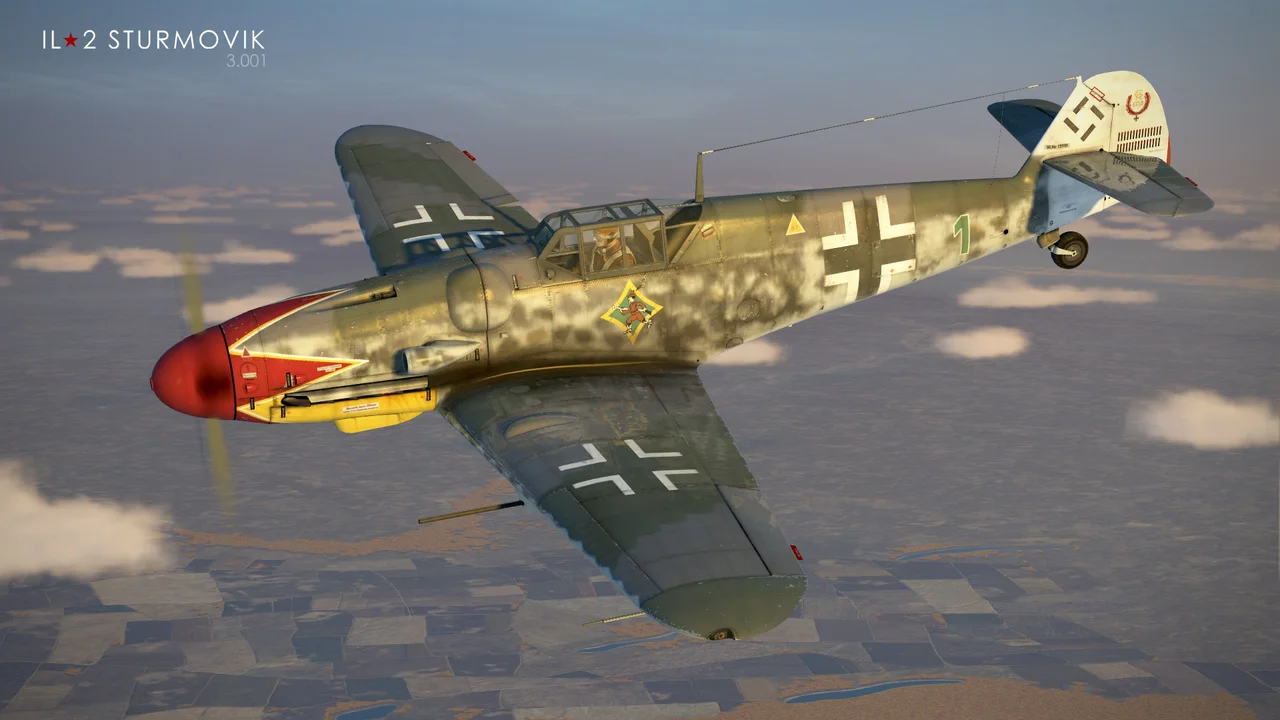
IL-2 Sturmovik: Bf 109 G-6 Collector Plane adds the Bf 109 G-6 to IL-2 Sturmovik: Battle of Stalingrad. The G-6 was the most-produced Messerschmitt 109 model of the war, with over 12,000 built after production began in February 1943. It was developed to increase firepower and served in aerial engagements over the Eastern and Western fronts, the Mediterranean, and in Reich air defense. Germany also supplied the aircraft to its allies.
Aircraft and armament
The G-6’s fuselage-mounted small-caliber machine guns were replaced by 13 mm MG 131 guns. The U4 variant could carry a 30 mm MK 108 cannon in the engine cylinder block. The aircraft remained in production for more than a year, with further changes to engines, auxiliary systems and armament introduced during that time.
Its default armament is a 20 mm MG 151/20 gun with 200 rounds and a rate of fire of 700 rounds per minute, plus two 13 mm MG 131 machine guns, each with 300 rounds and a rate of fire of 900 rounds per minute. The aircraft is 8.94 m long, has a 9.97 m wingspan and a wing surface of 16.1 m².
Game modes
You can fly the Bf 109 G-6 in Quick Mission Builder and Multiplayer. In Career mode, it is available during the Battle of Kuban timeframe.
Modifications
The aircraft has these available modifications:
- Two wing-mounted MG 151/20 20 mm guns, with 135 rounds each. They add 212 kg and reduce speed by 12 kph.
- An MK 108 30 mm gun with 65 rounds, replacing the nose-mounted MG 151/20. It saves 6 kg and gives a minor speed gain.
- Four SC 50 general-purpose bombs weighing 55 kg each. The bomb rack adds 260 kg; speed decreases by 51 kph with the bombs and by 11 kph after they are dropped.
- An SC 250 general-purpose bomb weighing 249 kg. The bomb rack adds 279 kg; speed decreases by 31 kph with the bomb and by 10 kph after it is dropped.
- A fixed-loop Peilrahmen PR 16 radio compass, adding 10 kg and causing a minor speed loss.
- Removal of the pilot’s armored headrest for an improved field of view, saving 8 kg and giving a minor speed gain.
- An alternative armored transparent triplex headrest for better visibility, adding 10 kg and causing a minor speed loss.
Aircraft performance
The Bf 109 G-6 has a DB-605A engine. Its maximum power is 1,480 HP in Emergency mode at sea level and 1,360 HP in Emergency mode at 5,600 m; in Combat mode, it produces 1,310 HP at sea level and 1,250 HP at 5,800 m. Nominal engine settings are 2,300 RPM and 1.15 ata with unlimited operating time. Combat power is 2,600 RPM and 1.3 ata for up to 30 minutes, while Emergency power is 2,800 RPM and 1.42 ata for up to 1 minute.
Maximum true air speed is 529 km/h at sea level in Emergency mode, 505 km/h at sea level in Combat mode, 547 km/h at 2,000 m in Combat mode, and 632 km/h at 7,000 m in Combat mode. The service ceiling is 11,800 m. Climb rates in Combat power are 20.1 m/s at sea level, 18.8 m/s at 3,000 m and 15.2 m/s at 6,000 m. Maximum-performance turns take 21.5 seconds at sea level and 28 seconds at 3,000 m, both at 270 km/h IAS. At 3,000 m, flight endurance is 2.2 hours at 350 km/h IAS.
The indicated stall speed is 160–177 km/h in flight configuration and 153–169 km/h in takeoff or landing configuration. The stall angle of attack is 19.8° in flight configuration and 17° in landing configuration. The dive speed limit is 850 km/h, and the maximum load factor is 10.5 G. Takeoff speed is 155–180 km/h, glideslope speed is 195–205 km/h, and landing speed is 150–155 km/h, at a landing angle of 13.7°.
The aircraft weighs 2,583 kg empty, 2,734 kg at minimum weight with no ammunition and 10% fuel, 3,100 kg at standard weight and 3,400 kg at maximum takeoff weight. It carries 304 kg or 400 l of fuel and has a useful load of 817 kg. Its combat debut was in February 1943. Performance ranges account for possible aircraft mass ranges; maximum speeds, climb rates and turn times use standard aircraft mass, and climb rates and turn times are given for Combat power. The figures are for international standard atmosphere (ISA).
Flying the Bf 109 G-6
The engine systems are extensively automated: in normal flight, you control speed with the throttle and do not need to set engine revolutions, mixture or supercharger gear manually. Radiator shutters normally operate automatically, but a special manual mode is available for specific situations. The aircraft has no flight-control trimmers; ground personnel can set its bendable trim tabs before flight. You can also adjust the horizontal stabilizer manually: it should be set to +1° before takeoff and −4° to −5° before landing, and can be used to trim the flight stick in flight. In a deep dive, set it so you have to push the stick forward to hold the dive angle.
Automatic wing slats deploy as the angle of attack increases, making the approach to a stall softer. Landing flaps are extended by a manual mechanical system, so they need to be lowered well before final approach. Markers on the left-wing flap show its extension, which can be set to any angle up to 40°. The tail wheel is locked manually; lock it for long straight taxiing and before takeoff and landing. The left and right wheel brakes operate independently through the upper parts of the rudder pedals.
The fuel gauge shows total fuel remaining, and a warning light comes on when 80 liters remain. The cockpit canopy cannot be opened in flight and should be closed before takeoff to prevent damage; it has an emergency release for bailouts. The bomb rack releases bombs one at a time, and the gunsight has a sliding sun filter. To reduce swinging from prop wash while taxiing, switch the propeller pitch control to manual and set the pitch to minimum.
Skins
The aircraft includes these skins:
- Standard pattern.
- Default winter camouflage in white.
- Hptm. Karl-Heinz Langer, 7./JG 3, Bad-Worishofen, October 1943.
- Fw. Heinrich Bartels, 11./JG 27, Kalamaki, November 1943.
- Major Hermann Graf, I./JG50 commander, Wiesbaden-Erbenheim, September 1943.
- Ofw. Elias Kühlein, 4./JG 51, Radomir, June 1944.
- Uffz. Rudolf Dreesmann, 12./JG 51, Lisyatichi, May–June 1944.
- Major Gerhard Barkhorn, II./JG 52 commander, Anapa, September 1943.
- Lt. Erich Hartmann, 9./JG 52 commander, Nowo-Zaporozhye, October 1943.
- Oblt. Wilhelm Schilling, 9./JG 54 commander, Ludwigslust, February 1944.
- Oblt. Robert Weiss, 10./JG 54 commander, Idriza/Pskov, November 1943.
- Lt. Manfred Dieterle, 3./JG 300 commander, Bonn-Hangelar, April 1944.
- Oblt. Gerhard Stamp, 8./JG 300 commander, Oldenburg, August 1943.
- Oblt. Heimo Emmerstorfer, 1./NAGr. 12, Mostar, Spring 1944.
- Hdgy Lászlo Molnár, 102/I Ö.V.Szd., Kalinovka, January 1944.
- Ylik. Osmo Länsivaara, 1./HLeLv 34, Lappeenranta, June 1944.
Frequently asked questions
The best price for IL-2 Sturmovik: Battle of Stalingrad IL-2 Sturmovik: Bf 109 G-6 Collector Plane is $19.99 at Steam. It is the only shop with an offer that activates in your country.
No. IL-2 Sturmovik: Battle of Stalingrad IL-2 Sturmovik: Bf 109 G-6 Collector Plane is DLC and only works with IL-2 Sturmovik: Battle of Stalingrad.
The minimum requirements for IL-2 Sturmovik: Battle of Stalingrad are: Windows 10, Intel Core i5, 16 GB RAM, 95 GB storage. It runs on Windows only. The recommended specs are in the System requirements section.
Yes. IL-2 Sturmovik: Battle of Stalingrad has multiplayer and a single-player mode. It supports online co-op and online PvP.
No. Valve rates IL-2 Sturmovik: Battle of Stalingrad as Unsupported on the Steam Deck.
Steam lets publishers create keys to sell in other shops. Once you activate a key, the game is yours to keep, just like a store purchase.
Disclaimer: CD keys have an inherent 1–2% average failure rate. Check the shop terms for buyer protection info. Steam offers no buyer protection for keys bought in other shops and doesn't refund them.
Similar games

X-Plane 11
$29.99
1 offer
Combat Wings: Battle of Britain
−88%$0.59
$4.9923 offers
Microsoft Flight Simulator X: Steam Edition
$24.99
2 offers
Project Wingman
−53%$11.72
$24.9915 offers
Ace Combat 7: Skies Unknown
−77%$13.48
$59.9923 offers
Squad 44
−82%$3.47
$19.9924 offers
VTOL VR
−75%$7.43
$29.9912 offers
Battlefield V
$8.67
10 offers
Scramble: Battle of Britain
−46%$15.99
$29.9919 offers
Bomber Crew
−90%$1.55
$15.9926 offers
IL-2 Sturmovik: Cliffs of Dover Blitz
−86%$1.33
$9.9917 offers
European Air War
$9.99
2 offers