

Gridworld
Offers


Trailers & screenshots
1 / 12
About Gridworld
Gridworld is a 2D, grid-based artificial life and evolution simulator. You run an ecosystem of virtual creatures that struggle to survive, adapt and evolve through natural selection. You can watch them find food, avoid danger and compete, or use world-editing tools and scenarios to shape their environment.
Creatures and behavior
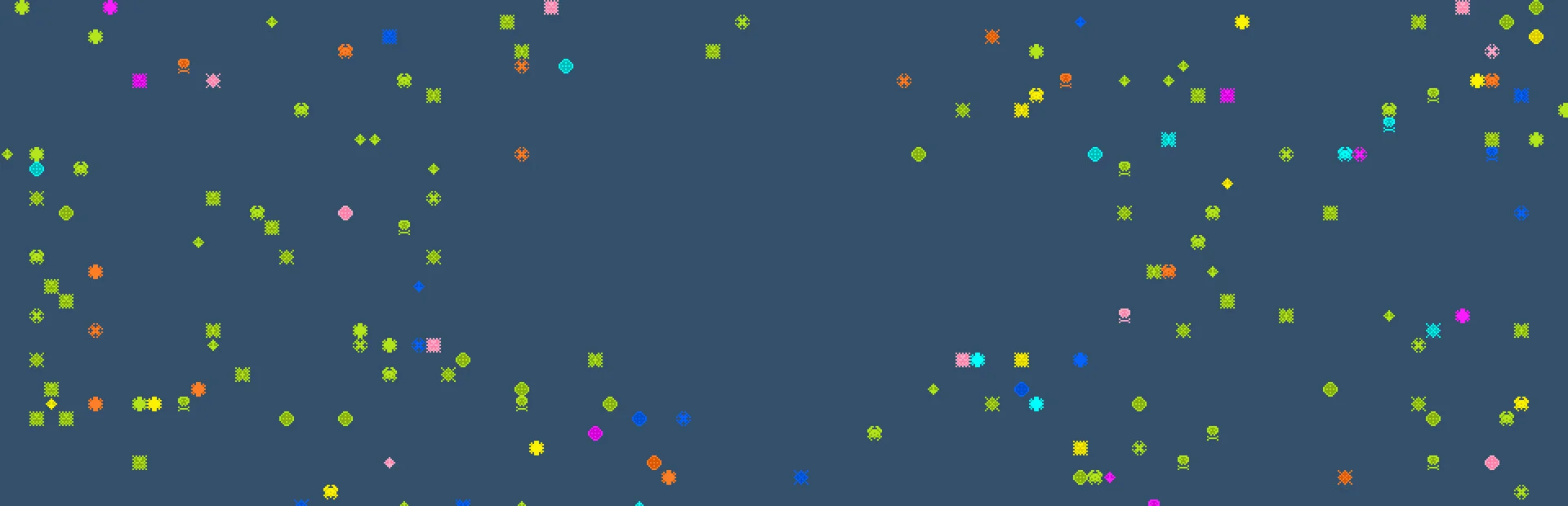
Creatures appear as colored tiles containing tiny subcells that represent neurons. Each has a body and a neural-network brain encoded in its DNA. Input neurons sense the environment, signals pass through the network, and output neurons trigger behaviors such as moving, rotating, eating, attacking and reproducing. Successful creatures eat to stay alive and can eventually reproduce.
Starting evolution
A new world begins full of food and randomly generated creatures. Most cannot feed or reproduce, so their genes die with them. Eventually, a random DNA combination may produce a creature that can eat and reproduce; it can multiply rapidly, causing a population explosion and starting evolution.
If you do not want to wait for the first self-replicating creature, you can choose from several scenarios with simple premade creatures. These let evolution begin immediately, so you can observe adaptation and natural selection from the start.
Mutation and selection
When creatures reproduce, their DNA may mutate. Mutations can be beneficial, harmful or neutral; successful ones spread, while unsuccessful ones die out. This cycle of mutation and selection drives adaptation. Because creatures live fast, you can observe evolution over hours or days rather than thousands of years.
Shape the simulation
Evolution happens automatically: you can start a simulation, let it run and check back later to see what has emerged. For more control, you can create challenges in the world editor, adjust simulation settings to change environmental conditions, or intervene during a simulation and see how populations respond to new challenges.
What may emerge
Every simulation is unique. Over time, you may observe:
- Food-finding skills and danger-avoidance behaviors
- Predatory ambush tactics
- Coevolutionary arms races
- Temporary multicellular clusters, where creatures combine into larger forms to hunt prey
- Population booms and busts
- Predator–prey population splits
- Speciation, as populations divide into distinct species adapted to different niches
- Viruses and parasites that replicate by exploiting other creatures
- Viral outbreaks that can wipe out large parts of the population
Frequently asked questions
The best price for Gridworld is $1.99 at Steam. It is the only shop with an offer that activates in your country.
The minimum requirements for Gridworld are: Windows 10, Intel HD Graphics 4000, 8 GB RAM, 500 MB storage. It runs on Windows only. The recommended specs are in the System requirements section.
No. Gridworld is a single-player game.
Yes. Gridworld is the full base game. You need nothing else to play it.
Steam lets publishers create keys to sell in other shops. Once you activate a key, the game is yours to keep, just like a store purchase.
Disclaimer: CD keys have an inherent 1–2% average failure rate. Check the shop terms for buyer protection info. Steam offers no buyer protection for keys bought in other shops and doesn't refund them.
Similar games
WorldBox
$19.99
2 offers
Planetary Life
$11.99
1 offer
The Sapling
$17.99
1 offer
Spore
$19.80
$19.996 offers
Thrive
−10%$4.49
$4.992 offers
Anlife: Motion-Learning Life Evolution
$13.99
1 offer
Timberborn
−47%$18.49
$34.9919 offers

Universe Sandbox
−49%$15.19
$29.9917 offers

Sandboxels
$0.99
1 offer
The Bibites: Digital Life
$9.99
1 offer
The Universim
−91%$2.41
$29.9921 offers
Ecosystem
−69%$6.14
$19.9912 offers