

Code: Terraform
Offers


Trailers & screenshots
1 / 12


About Code: Terraform
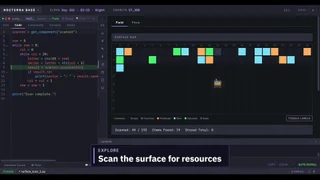
Code: Terraform is an automation and programming game set on a frozen alien world. Your ship is silent and its sensors are offline, so you bring the planet to life by writing scripts in a language modeled after Python. You use real code rather than visual programming or drag-and-drop tools, with an in-game editor, console and documentation.
Restore your systems
Bring your base online one script at a time. Calibrate sensors, activate solar power, and turn raw instrument data into useful information. You interact with every system through code: instead of clicking to mine, you write a mining script, and instead of managing a power grid by hand, you script its operating policy. Solar trackers use your code to follow the sun, and drone fleets fly when your code dispatches them.
Automate your industry
Scripts run autonomously and concurrently while you plan your next steps. Solar trackers follow the sun, rovers survey distant sites and drill promising ones, and smelters refine the material they bring back. As you script more systems, the planet responds to your work.
Earth also sends engineering contracts that challenge you to process data for rewards. You parse signals, filter datasets and calculate solutions; harder contracts pay more. Earn credits, buy machines, smelt ore into ingots and fabricate parts, then ship orders to Earth's contractors for credits, recipe unlocks and technology upgrades. The parts you can make include pipe segments, machine frames, circuit panels, turbine rotors, cargo pods, thruster assemblies and battery packs. Expand from a single solar panel to a planet-spanning industry.
Design the infrastructure
Drill for underground water, tap oil wells and cap geothermal vents to produce steam. Pipe these resources across the planet, balance backpressure and supply tier three machines that need continuous flow to run at full output. You can bridge pipes with overpasses and connect power subnets with line segments. Pipes and power lines are built tile by tile, and you design their layouts.
Use a tile-based blueprint editor to plan pipes, power lines and outposts. Then send a Pioneer equipped with a Constructor module to build the plan piece by piece, tile by exact tile.
Upgrade your machines
Mark I machines take you to a thin atmosphere, Mark II machines push toward breathable air, and Mark III machines require fluid input but unlock the climb to a terraformed planet. Earn upgrade packs through orders and apply them to deployed machines to change their output.
Build and direct drones
Assemble drones from chassis, thrusters and modular pods. Deploy outposts in resource-rich territory and operate them remotely. Write flight scripts to bring ore home, carry supplies out and recover stranded fleets. Charging stations and refueling pads keep drones flying, while recovery bays airlift those that fail to return. A drone's range depends on its battery and fuel, not on a track. Save a route as a library script and share it across your drones.
Program and debug
The programming environment includes syntax highlighting, autocomplete, signature help, type-aware completions, rename refactoring and inline documentation that opens with Cmd+click. Run multiple scripts at once and reuse shared code by importing library functions. Debug with breakpoints, log points, conditional breakpoints and three step modes. Dock the editor so you can watch your code and its results side by side.
Uncover the planet's story
There are no cutscenes or cinematics. Story details arrive through the systems you use: briefings, sensor data, encrypted transmissions and contract anomalies. As you terraform, sensor readings stop matching, unexpected warm patches appear and structures show up where they were not before. Mission control begins asking questions it should not need to ask. The planet responds not to your equipment, but to you; the truth unfolds through details in the work.
Learn as you work
The game provides documentation and hints, but no tutorials. You work out how things function as you go.
Frequently asked questions
The best price for Code: Terraform is $14.99 at Steam. It is the only shop with an offer that activates in your country.
The minimum requirements for Code: Terraform are: Windows 10, 4 GB RAM, 1 GB storage. It runs on Windows only. The recommended specs are in the System requirements section.
No. Code: Terraform is a single-player game.
No. Valve rates Code: Terraform as Unsupported on the Steam Deck.
Yes. Code: Terraform is the full base game. You need nothing else to play it.
Steam lets publishers create keys to sell in other shops. Once you activate a key, the game is yours to keep, just like a store purchase.
Disclaimer: CD keys have an inherent 1–2% average failure rate. Check the shop terms for buyer protection info. Steam offers no buyer protection for keys bought in other shops and doesn't refund them.
Similar games
The Farmer Was Replaced
−30%$6.99
$9.996 offers
Autonauts
−92%$1.55
$19.9913 offers
Oxygen Not Included
$24.99
2 offers
Infinifactory
−70%$7.42
$24.9916 offers
Dyson Sphere Program
$19.99
1 offer
Molek-Syntez
−94%$0.50
$9.999 offers
Opus Magnum
−51%$9.68
$19.9911 offers
Shenzhen I/O
−65%$5.12
$14.997 offers
Factorio
−12%$30.65
$35.0013 offers
Satisfactory
−30%$27.65
$39.9917 offers
Shapez
−97%$0.25
$9.9917 offers
The Crust
−75%$7.77
$31.9921 offers